

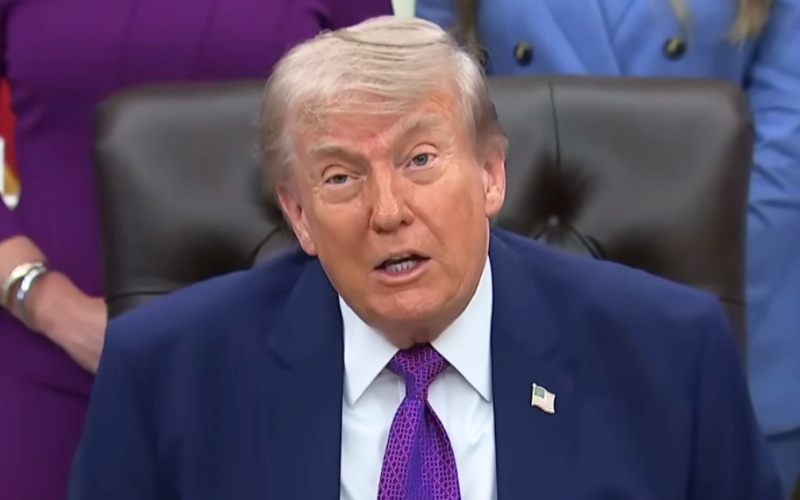
President Donald Trump is pushing for a temporary suspension of the federal gasoline tax as fuel prices continue to climb in the wake of escalating tensions tied to the Iran conflict, a proposal that would require congressional approval and could quickly run into fiscal and political resistance.
The idea surfaced during a phone interview with CBS News, where Trump described the move as a short-term measure aimed at easing pressure on drivers facing higher costs at the pump.
He emphasized that the suspension would be temporary, with the tax restored once prices stabilize.
“I think it’s a great idea,” Trump said. “Yup, we’re going to take off the gas tax for a period of time, and when gas goes down, we’ll let it phase back in.”
The federal gas tax—set at 18.4 cents per gallon on gasoline and 24.4 cents on diesel—feeds into the Highway Trust Fund, which supports road construction and public transit projects nationwide, according to Forbes.
The proposal comes as gasoline prices have risen sharply in recent weeks, with the national average reaching roughly $4.52 per gallon as global oil markets react to instability linked to the Iran conflict, including heightened concerns over shipping routes such as the Strait of Hormuz, a key global supply corridor.
While the announcement drew immediate political attention, the path to implementation is limited.
The federal gas tax is established by statute, meaning any suspension would require congressional action rather than executive authority alone.
That reality has already set off early maneuvering on Capitol Hill, according to CNBC.
Several Republican lawmakers quickly voiced support, including Missouri Sen. Josh Hawley, who said he plans to introduce legislation to suspend the tax, and Rep. Anna Paulina Luna (R-FL), who indicated she will advance a corresponding House proposal.
Democrats have previously explored similar relief measures during periods of elevated fuel costs, though those efforts have generally stalled amid concerns over how to replace the lost revenue that funds federal infrastructure spending.
The fiscal stakes are significant.
Analysts estimate that suspending the gas tax would reduce federal revenue by roughly $500 million per week, or more than $2 billion per month, placing additional strain on the Highway Trust Fund at a time when fuel tax receipts have already been under pressure.
That pressure is not new.
Over time, improvements in vehicle fuel efficiency and the gradual expansion of electric vehicle use have reduced per-gallon tax collections, creating long-term funding challenges for road and transit programs that depend on the levy.
Some states have already taken their own steps to blunt rising prices.
Indiana, Georgia, and Utah have all implemented temporary adjustments or suspensions of portions of their state fuel taxes, though the impact has varied depending on local market conditions and supply dynamics.
Even so, economists caution that federal relief may have limited effect at the pump.
One analysis estimates that eliminating the federal gas tax would reduce prices by less than 20 cents per gallon, a modest offset compared to recent increases driven primarily by global crude oil costs rather than domestic taxation.
Andrew Lautz of the Bipartisan Policy Center has noted that the benefit of a gas tax suspension diminishes as prices rise, since the federal levy represents a shrinking share of overall fuel costs during periods of market-driven spikes.
Energy Secretary Chris Wright has also indicated openness to measures aimed at easing consumer fuel costs, saying the administration supports “all measures” that could help reduce prices for households facing higher energy bills.
Beyond the immediate economic question, the proposal carries political implications as fuel costs remain a persistent concern for voters heading into the 2026 midterm cycle, where inflation and energy prices are expected to play a central role in congressional campaigns.
Trump also used the interview to weigh in on broader energy and foreign policy issues tied to the Iran conflict, including risks to global shipping lanes and ongoing diplomatic tensions affecting oil supply stability.
For now, the proposal remains in its early stages, with any movement dependent on congressional negotiations over both transportation funding and broader energy policy priorities in the months ahead.
