

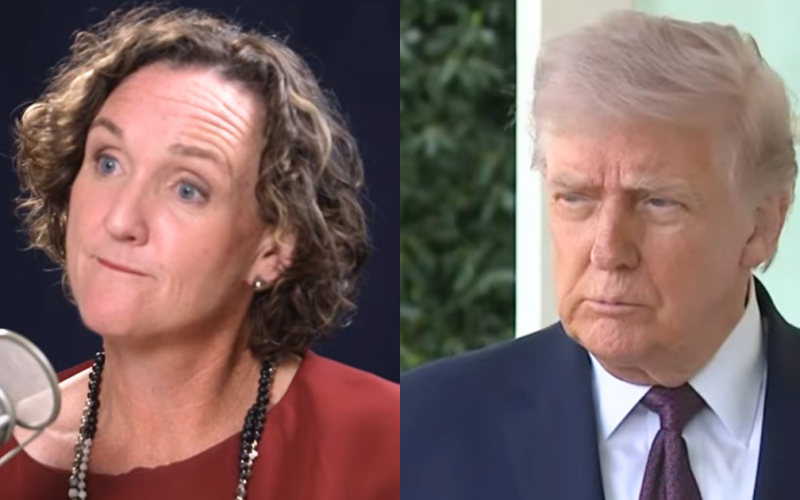
California gubernatorial candidate Katie Porter (D) is facing renewed criticism after a fundraising email sent to supporters drew attention for its timing and language, arriving less than a day after an assassination attempt targeting President Donald Trump and senior members of his administration.
The message quickly spread online, sparking debate over political rhetoric during an already volatile moment.
The email was reportedly sent roughly 18 hours after the incident and included sharply worded attacks on Trump that critics say were especially inflammatory given the circumstances.
One passage in particular became the focus of online discussion after screenshots circulated across social media platforms.
“We know what Trump is willing to do and how far he is willing to go — he’s willing to kill people in the streets, to rip healthcare away, to ruthlessly attack our democracy,” the email stated, according to LifeZette.
The language, combined with the timing, prompted immediate reactions from political commentators and users online, many of whom questioned whether such messaging was appropriate so soon after a violent attempt on a sitting president.
Critics also noted that the email contained profanity, further intensifying scrutiny as it spread.
Porter, a Democrat currently serving in Congress and running for governor of California, has not publicly addressed the email as of the latest reporting.
It remains unclear whether the message was pre-written and scheduled or sent after the assassination attempt occurred.
While the controversy initially centered on Porter, it quickly expanded into a broader discussion about political rhetoric across party lines following the attack.
Law enforcement has not released full details about the suspect or motive, but the incident has already prompted heightened attention to how political messaging is delivered during crises.
Republican officials and commentators were among the first to condemn the email, arguing that its wording reflected a broader escalation in political hostility.
Some also pointed to Porter’s past communication style as part of the criticism, though her campaign has not issued clarification regarding the message, as noted by Townhall.
The backlash also reignited attention on other political figures whose past comments about Republicans have resurfaced in recent days.
Senate Minority Leader Hakeem Jeffries (D-NY) faced renewed scrutiny over a prior remark calling for “maximum warfare,” which critics referenced in discussions about political rhetoric in the aftermath of the assassination attempt.
As the email circulated, the broader debate over political speech intensified, with officials and analysts on both sides acknowledging increased concerns about inflammatory language during a period of heightened national tension.
Porter’s campaign has not said whether it will review the email or issue any clarification.
Critics continue to point to the timing as a central issue, arguing that even routine campaign messaging can become significant when released in the immediate aftermath of political violence.
The episode has become part of a wider national conversation about rhetoric, responsibility, and the boundaries of political communication during moments of crisis.
As tensions remain elevated, the incident underscores how quickly campaign messaging can escalate into a broader political flashpoint when intersecting with national events involving violence and security concerns.
