

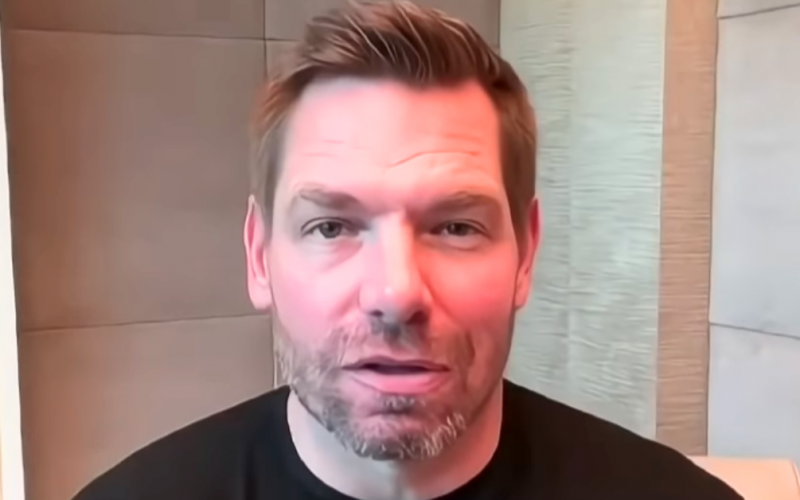
A federal criminal investigation into former Rep. Eric Swalwell took a dramatic public turn this week when surveillance video surfaced showing him flanked by FBI agents inside San Francisco International Airport.
Agents intercepted the former California congressman on Aug. 15 immediately after his plane landed.
The footage places him near his arrival gate, where a cluster of federal agents approached him as everyday travelers streamed past in the background.
Swalwell can be seen in casual clothing — a hat, black sweatshirt, and sneakers — engaging directly with the agents.
Nothing in his body language suggests resistance; he remains composed and cooperative for the duration of the recorded exchange.
From there, the cameras track his movement through the terminal.
Agents walk alongside him as he carries a backpack and pulls a rolling suitcase toward an escalator, eventually guiding him into a hallway designated as restricted access.
The footage ends with him entering a room already occupied by several other individuals.
According to records connected to the warrant, agents formally executed the search at roughly 8:25 p.m. that night.
What they walked away with included a white Apple iPhone, its charging cable, a wall adapter, and an Apple MacBook Pro.
Standard procedure was followed at the conclusion of the search: agents handed Swalwell both a copy of the warrant and a written inventory documenting everything confiscated.
Notably, the footage never shows handcuffs or an arrest — Swalwell walked free once the search wrapped up.
This airport encounter turned out to be just one piece of a larger operation.
A second wave of search warrants hit Swalwell’s Washington, D.C., home the very next day, with agents collecting additional material relevant to the ongoing case.
Legal experts examining the warrant paperwork noted its reliance on a federal civil-rights statute — a law more commonly associated with prosecuting government officials accused of exploiting their office for improper purposes.
That legal detail has intensified speculation about the investigation’s true scope.
Observers are now questioning whether prosecutors are probing potential links between Swalwell’s official duties and a string of sexual misconduct allegations leveled against him.
Swalwell continues to deny any wrongdoing in connection with these claims.
The accusations themselves are numerous and severe.
A former member of his staff alleges that Swalwell raped her at a time when she was too intoxicated to consent — an allegation first brought to light by the San Francisco Chronicle.
A different woman has come forward claiming Swalwell drugged and sexually assaulted her in a 2018 incident.
Separately, two more women say he sent them explicit images they never requested or welcomed.
It bears noting that none of these claims have produced a criminal conviction. At this stage, they remain unproven allegations rather than established legal findings.
Political fallout arrived swiftly. Swalwell’s bid to become California’s next governor collapsed under the weight of the growing scandal.
That collapse came just before he stepped down from his congressional seat on April 14 — a resignation timed with a looming House Ethics Committee investigation into alleged misconduct and sexual assault involving a subordinate employee.
Before abandoning his gubernatorial campaign altogether, Swalwell’s attorney took the unusual step of contacting his accusers directly.
The letter referenced alleged “nonconsensual sexual encounters” and cautioned that Swalwell might pursue defamation litigation against those spreading the claims online.
Federal scrutiny began building months earlier.
The Department of Justice opened its formal investigation in April, right as public allegations against the former congressman started piling up.
A parallel state ethics inquiry is also reportedly examining his conduct.
Swalwell’s political résumé stretches back years.
He held his California congressional seat across seven terms, following earlier work in local government and a stint as a prosecutor.
His political ambitions once reached national scale, including a short-lived run for the 2020 Democratic presidential nomination.
Until now, the public had never seen direct visual evidence of federal agents physically confronting Swalwell.
This newly surfaced footage changes that, documenting in real time the moment his phone and laptop left his possession and entered federal custody.
Prosecutors have not disclosed what they expect to find on the seized devices, and no formal charges have been filed against Swalwell as this story continues to develop.
