

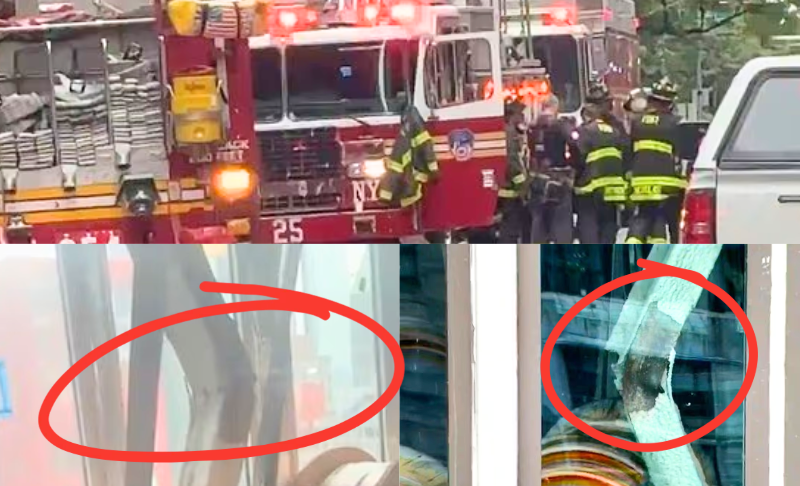
Thousands of commuters were sent scrambling through Midtown Manhattan on Tuesday morning as emergency crews discovered a 37-story tower was actively buckling and shifting, prompting one of the most dramatic building evacuations New York City has seen in years.
The high-rise at 235 East 42nd Street, formerly the corporate home of pharmaceutical giant Pfizer, is currently being transformed from office space into apartments.
That transformation ground to a halt when structural engineers spotted signs the building’s steel frame was failing under stress.
City officials didn’t just clear the tower itself.
Eight surrounding buildings were emptied, and a nine-block perimeter was sealed off entirely as emergency crews raced to determine whether the structure could be saved from a partial collapse.
Mayor Zohran Mamdani addressed the crisis directly Tuesday afternoon, revealing that monitoring teams stationed at the site since dawn had watched the problem worsen in real time.
“The concern is that since we have been on site in the early morning, we have seen continued shifting of the structure,” he told reporters.
Behind the scenes, FDNY crews used specialized sensor equipment to track the building’s movement from street level, catching a slow-motion structural emergency unfolding dozens of stories above the sidewalk.
FDNY Chief of Department John Esposito offered New Yorkers a technical explanation paired with a sobering assessment of what could happen next.
“The way this building is constructed, it’s a steel-frame building, so it would not be a total collapse, it would be more of a localized collapse,” Esposito explained. He didn’t mince words about the ongoing danger, adding: “That remains our concern – that it’s moving. … We have seen continual movement. It does mean it is not stable.”
A reporter asked Esposito point-blank whether the tower risked folding in on itself. His response left little room for comfort: “Possibly.”
Someone familiar with the investigation described the failure in visceral terms, comparing the stress on the steel to snapping a small branch.
“It’s like squeezing both ends of a twig,” the source said, pinpointing the damage to the seam where the building’s original framework connects to newer construction added on top. “And it is buckling,” the source added.
Weather forecasts only heightened the sense of urgency. With rain and wind expected to move through the region later in the week, officials worried the added environmental strain could tip an already unstable structure toward failure.
A six-person team — pulling from the FDNY, the city’s Buildings Department, and the project’s contractor — finally entered the building midafternoon to survey the damage up close and begin planning how to shore it up.
The structure had reportedly held still for about two hours leading up to their entry. Overhead, drones circled the tower, with operators paying close attention to its rear façade.
The lockdown extended well beyond the building’s footprint. NYPD and FDNY officers sealed off a “frozen zone” running from East 40th to 45th streets between First and Third avenues, halting every pedestrian and vehicle in the area over fears that falling debris could strike the streets below.
Mamdani laid out the specific damage: two structural columns on the 21st floor had already buckled, and a third was beginning to show movement. “The building remains unstable,” he said.
The project is no small undertaking. It ranks as one of the largest office-to-residential conversions in the entire country, with developers aiming to deliver 1,600 apartments by 2027.
According to city Buildings Commissioner Ahmed Tigani, crews had been busy stacking 11 brand-new floors on top of an existing 22-story base when the trouble emerged.
The floors showing damage — the 17th and 21st — sit just beneath those new additions, sources said.
Tigani confirmed a formal investigation into what caused the failure will follow, but said the immediate priority is making the building safe, which will likely require hauling in emergency beams and columns for reinforcement.
A structural engineer representing the Structural Engineers Association of New York laid out several possible explanations for The Post, cautioning that a full answer won’t come until the building is stabilized.
“Could be one or all of many things, which will be investigated once the building is shored,” the engineer said, pointing to potential culprits like construction materials overloading the floors, an undisclosed removal of a load-bearing element during a past renovation, or a flaw dating back to the original design or build.
A separate source close to the matter said investigators are also examining whether the steel installed during construction ever deviated from the building’s original blueprints.
Mamdani closed his remarks with a blunt reminder that the danger was far from over, urging residents and commuters alike to keep their distance. “This is a minute-by-minute assessment,” he said.
