

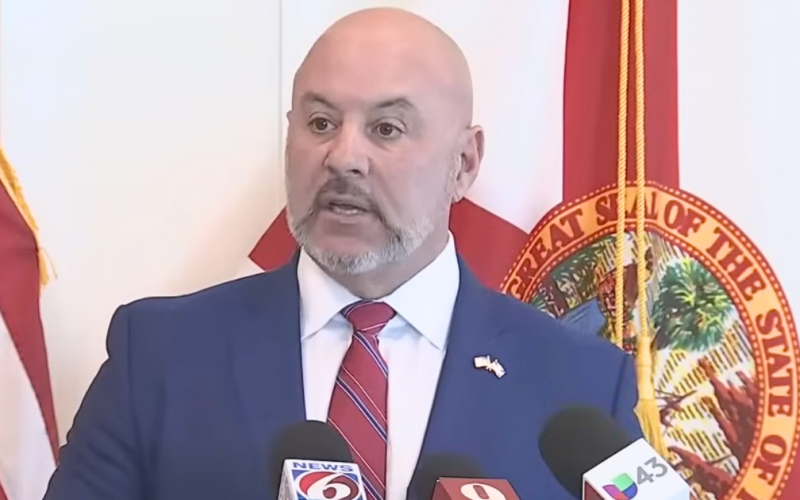
Florida Chief Financial Officer Blaise Ingoglia is sharpening his criticism of sanctuary immigration policies, arguing that elected officials who support them bear responsibility for crimes committed in jurisdictions with such laws.
He framed the issue as a broader breakdown in coordination between states, where differing levels of cooperation with federal immigration authorities can create gaps in enforcement.
Ingoglia said those inconsistencies can allow individuals to move between jurisdictions and avoid sustained enforcement attention.
“An immigrant commits a crime in, let’s say, in in in Oregon, and they’re an illegal immigrant, and sometimes these crimes are heinous,” Ingoglia said.
He also argued that when local agencies decline to fully cooperate with federal immigration detainers, it can lead to uneven outcomes across states and complicate enforcement efforts nationwide.
At the center of the debate are sanctuary policies, which reduce or restrict local cooperation with federal immigration enforcement.
Supporters say those limits are meant to encourage trust between immigrant communities and police so crimes can be reported without fear.
Critics counter that the policies reduce coordination with federal agencies and weaken enforcement of immigration law.
Rather than focusing on individual cases, Ingoglia tied his concerns to the idea that policy choices themselves shape outcomes, arguing that elected officials who support sanctuary frameworks should be held accountable for the consequences he believes follow.
“The easiest way to get rid of sanctuary policies is maybe we should start charging the politicians with crimes that vote for the sanctuary policies and make them accessories to whatever crimes are committed by illegal immigrants in those jurisdictions,” Ingoglia said, according to LifeZette.
He expanded on that position by emphasizing what he views as responsibility at the policy level rather than at the level of individual enforcement decisions or isolated incidents.
“Because, to me, they are absolutely complicit in the crime because it never should have happened in the first place. But for those sanctuary policies, but for some, some politician voting, thinking that that’s okay,” Ingoglia said.
Alongside his remarks, Ingoglia has also backed a broader set of proposals in Florida aimed at tightening immigration-related enforcement.
These include stronger employment verification requirements, tighter rules for businesses hiring unauthorized workers, and expanded restrictions on access to certain state programs, according to Patirot Fetch.
Supporters of the effort say the goal is to improve consistency in enforcement and reduce pressure on local systems.
State leaders backing the proposals have pointed to public safety concerns and resource strain as key motivations behind the push for reform.
Republican Sen. Jonathan Martin said that “illegal immigration has negatively impacted every community in our state.”
Sheriff Robert Hardwick also pointed to the operational strain on law enforcement agencies, citing the challenges local departments face in managing immigration-related issues alongside other public safety demands.
Lawmakers supporting stricter measures have cited various data points in broader debates over cost and enforcement impact, though those interpretations remain politically disputed.
Advocates for tougher enforcement say the figures highlight systemic gaps, while critics argue they oversimplify complex migration and enforcement dynamics.
Rep. James Comer (R-KY) has also weighed in on sanctuary policy debates, stating, “Sanctuary policies provide sanctuaries for criminal illegal aliens. These reckless policies are a clear and present danger to Americans across the country.”
Opponents of expanded enforcement warn that broader penalties and restrictions could create unintended consequences for immigrant communities and raise concerns about overreach, while supporters argue stricter rules are necessary to ensure consistent enforcement across states.
As immigration policy remains a major issue across the country, Florida’s approach under Ingoglia is increasingly being viewed as part of a wider national struggle over enforcement authority, state control, and how immigration laws are implemented in practice.
WATCH:
