

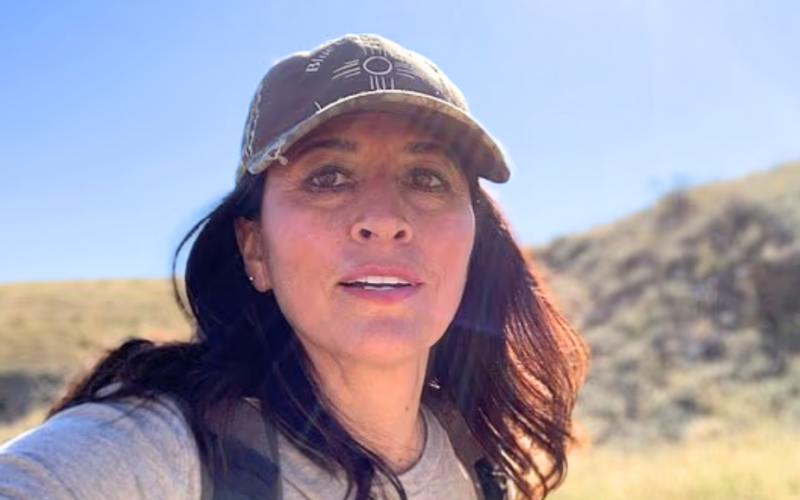
A woman who worked at one of America’s most secretive federal laboratories has been found dead, nearly a year after she staged what investigators describe as a calculated disappearance from her own home — and left almost nothing behind for anyone to follow.
New Mexico State Police made the announcement confirming the identity of remains recovered in Carson National Forest, positively identifying them as belonging to Melissa Casias, 54, an administrative assistant employed at Los Alamos National Laboratory.
A hiker stumbled upon the remains on May 28, 2026, in the McGaffey Ridge area of the forest — a stretch of federally managed land that sits roughly six miles from the spot where Casias was last captured on camera, walking alone down a state highway.
Alongside her body, investigators recovered a handgun.
Who that weapon belonged to, and how it came to rest beside her remains, is something authorities have not yet answered. New Mexico State Police confirmed they are actively working to trace the firearm’s origins, a process that could take days.
The cause of Casias’s death has not been established. The Office of the Medical Investigator in New Mexico is conducting further testing, including a specialized anthropological examination of her remains.
Casias had worked at Los Alamos National Laboratory, a facility born out of the classified Manhattan Project during World War II and still deeply embedded in the nation’s nuclear weapons research apparatus.
Her vanishing on June 26, 2025, had not been an ordinary missing persons case from the start.
That morning, Casias drove her husband, Mark — a superintendent at the same laboratory — to work, a commute of roughly 70 miles from the family’s home in Ranchos de Taos.
She told him she needed to double back home after realizing she had forgotten her security access badge. Her husband, however, told investigators she possessed that badge when she dropped him off, as she would have needed it to clear the facility’s security checkpoints.
She then stopped at her daughter Sierra’s place of employment, delivered a sandwich, and repeated the same story about the forgotten badge. She said she planned to work remotely for the day.
What she actually did upon returning home raised far more questions than it answered.
Inside the residence, family members later discovered her work phone, her personal phone, her identification, and her purse — all left behind.
Both phones had been subjected to factory resets, meaning every call, message, and contact had been deliberately erased before she walked out the door.
Surveillance cameras caught her one final time at approximately 2:20 p.m. local time, moving eastward and alone along State Road 518, roughly three miles from the house. She carried a backpack and was on foot. The cameras never picked her up again.
The forest where her remains surfaced sits five to six miles east of that same road.
Casias’s case drew national attention not only because of the laboratory she worked for, but because of the eerie pattern it appeared to fit.
Her disappearance has been grouped alongside a mounting list of scientists, government contractors, and federal employees connected to classified or highly sensitive research who have gone missing or turned up dead in recent years.
Former FBI Assistant Director Chris Swecker raised alarms publicly earlier this year, telling the Daily Mail that individuals in administrative roles at high-security facilities often carry access to the same sensitive material as the researchers they support.
“In a classified lab, or just a high clearance lab, they would basically be in the know on what’s going on,” Swecker said. “And it wouldn’t be the first time their administrative assistant has been targeted.”
Casias’s own family pushed back on that characterization, with relatives and private investigators stating she had lost her security clearance prior to her disappearance due to financial strain she and her husband were facing.
House Oversight Committee Chairman James Comer of Kentucky has publicly stated that Congress views the broader pattern of disappearances as a national security threat, calling it unlikely to be a coincidence.
The McGaffey Ridge area where Casias’s body was recovered is part of a large-scale U.S. Forest Service restoration project spanning approximately 30,000 acres south of Taos.
Active restoration crews, operating in partnership with the State of New Mexico, had been working the land since December 2025 — a detail her family flagged in a public statement, noting she was found in an area that had already been searched.
“This is a lot to process, our hearts are heavy and we fully intend to continue to pursue answers for justice,” the family’s statement read.
The investigation remains open.
