

A decorated military officer who spent decades at the highest levels of America’s defense infrastructure stepped out of his front door one February morning and ceased to exist. No farewell. No distress call. No body.
Retired Air Force Major General William “Neil” McCasland, 68, walked away from his Albuquerque home on February 27 — and the search that followed has raised questions that go far beyond one missing man.
McCasland was not an ordinary retiree. He served in senior Pentagon positions spanning nuclear science, space research, and national defense programs.
He commanded the Air Force Research Laboratory at Wright-Patterson Air Force Base — the New Mexico installation where wreckage from the 1947 Roswell incident was reportedly delivered.
His wife, Susan Wilkerson, stepped out for a doctor’s appointment at 11:10 a.m. She returned 54 minutes later to an empty house. Every vehicle remained in the garage. His phone sat on a surface inside. So did his prescription glasses and electronics.
Wilkerson dialed 911. “My husband is missing … I have some indication that he must have planned not to be found,” she told dispatchers.
“I think he’s on foot. All of our cars and bicycles are in the garage.” Three hours had passed since McCasland was last seen speaking with a repairman at the home around 10 a.m.
Investigators believe he departed with his wallet, hiking boots, and a .38-caliber revolver. A gray Air Force sweatshirt turned up roughly one mile east of the property. Authorities have declined to confirm whether it belonged to the general.
Then the federal government arrived uninvited. In March, FBI agents entered the McCasland investigation without a request from local law enforcement — a direct departure from established protocol.
A Bernalillo County Sheriff’s Office official confirmed the breach to reporters. “I’m not sure why [the FBI] chose to come in on this one, but that was their request,” the source said.
McCasland’s name had already surfaced in unexpected places. Missouri Republican Representative Eric Burlison, sitting on the House Oversight Committee, disclosed he had contacted McCasland twice about UAP research before the disappearance.
The general also appeared in the WikiLeaks release of Clinton campaign chairman John Podesta’s emails.
Former Blink-182 frontman Tom DeLonge had named McCasland as his internal government source on alien intelligence, and leaked calendar data showed a meeting scheduled between DeLonge, Podesta, and McCasland for January 24, 2016.
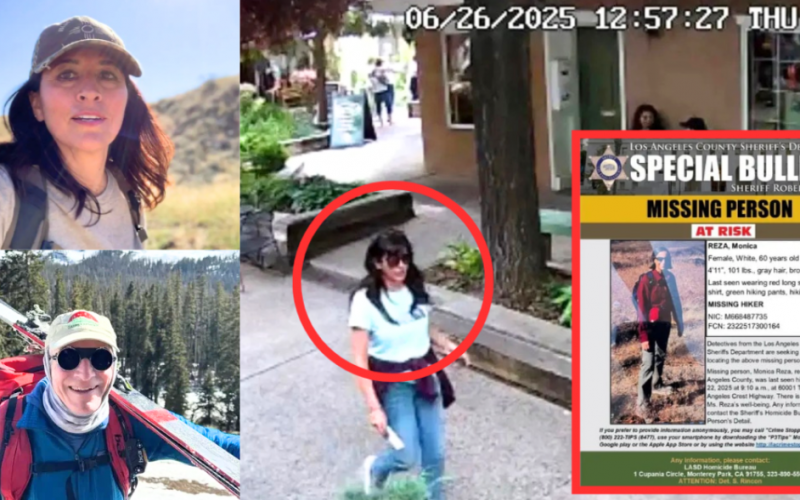
McCasland’s professional reach extended to an aerospace engineer named Monica Jacinto Reza, whose work he oversaw and funded at the AFRL. Reza, 60, developed a specialized nickel-based super-alloy called Mondaloy, engineered for rocket propulsion.
On a sunny Saturday in June 2025, she set out on a paved, well-traveled trail through the Angeles National Forest in Los Angeles County wearing a bright red sweater.
She was walking directly behind two companions. She never came out the other side.
Reza holds a senior tech fellow position at Aerojet Rocketdyne and maintains project ties to NASA’s Jet Propulsion Laboratory.
The Los Angeles County Sheriff’s Department threw significant resources at the search — helicopters, scent dogs, ground teams, thermal imaging, wave-locating technology, and drone units. None of it produced Reza.
The department has since contacted out-of-state law enforcement agencies to compare details with “other cases similar in nature.” The investigation remains open. “At this time, there are no clear indications of foul play,” officials stated.
McCasland had also held oversight responsibilities at Los Alamos National Laboratory.
One of that facility’s roughly 15,000 employees was Anthony Chavez, 78, a retired research and development engineer who spent the bulk of his career at the Dual-Axis Radiographic Hydrodynamic Test facility — a core node in America’s nuclear weapons research infrastructure.
On May 8, 2025, Chavez was reported missing after he was last observed leaving his home near Los Alamos on foot. His wallet, keys, and cigarettes remained inside. His car did not move.
Police found no evidence of forced entry or struggle. Cadaver dogs swept the area. Chavez has not been located.
Three months after Chavez vanished, Steven Garcia, 48, exited his Albuquerque home on the morning of August 28 carrying only a handgun. He left his wallet, phone, keys, and vehicle behind.
Garcia worked as a property custodian — a top-security-clearance position involving high-level oversight — at the Kansas City National Security Campus’s Albuquerque facility, which produces more than 80 percent of the non-nuclear components used in U.S. nuclear weapons and manufactures nuclear parts for the AFRL.
Albuquerque police have offered no new developments. “The case is still active,” a department spokesperson said.
On June 26, 2025, Los Alamos National Laboratory employee Melissa Casias, 53, dropped lunch off for her daughter, told family she planned to work from home, and disappeared.
Security cameras recorded her at 2:18 p.m., walking east along State Road 518 toward Pot Creek — alone, moving quickly.
Her car was parked outside her house. She left both her personal and work cellphones behind. Both had been factory-reset.
Her mother, Joann Mondragon, 78, has not received updates from New Mexico State Police in months. “The way things happened it doesn’t make any sense that someone would have taken her. None of it makes any sense.
Melissa would not leave her daughter. They were very close,” Mondragon said. “We’ve heard nothing for months. They just stopped communicating.”
The family retained retired homicide detective and private investigator Thomas McNally. His investigation recently produced a pair of shoes recovered in Carson National Forest that match those Casias wore on the day she was last seen.
DNA testing is underway. McNally and the family believe Casias was murdered by someone she knew — and that her employment had nothing to do with it.
“She was an administrative assistant who was responsible for purchasing routine office supplies,” McNally said. He is actively lobbying New Mexico lawmakers to reclassify the case as a homicide.
