

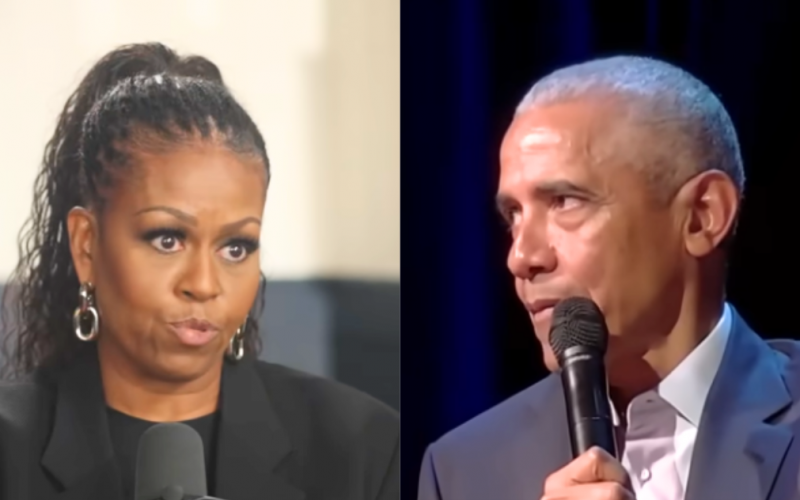
Chicago’s South Side witnessed a long-anticipated moment this week when the Obama Presidential Center finally welcomed the public — but the spotlight quickly shifted from the building itself to a four-letter word Michelle Obama used to define her future.
Speaking alongside former President Barack Obama in a sit-down interview with Good Morning America co-host Robin Roberts, the former first lady fielded a deceptively simple question: what single word captures the next chapter of her life?
Her answer was immediate. “Me,” she said.
Her husband took a lighter tone. When posed the same question, Barack Obama replied with one word of his own: “Fun.”
The candid exchange landed just as the center’s ribbon was cut, drawing fresh public attention to both the Obamas and the institution that consumed more than a decade of planning, fighting, and spending to bring to life.
The story of the Obama Presidential Center began in 2015, when the former president’s team unveiled plans to anchor his post-presidential legacy on Chicago’s South Side — a community with deep personal significance to both Obamas.
Planners pitched the development as a catalyst for economic revival in the area, promising that a flood of tourists and sustained investment would follow.
The nearly 20-acre footprint was designed to house a museum, public plazas, athletic facilities, manicured gardens, and rotating exhibits documenting the Obama years in the White House.
What supporters envisioned as a crown jewel for the South Side, however, others saw as an unwanted intrusion.
Critics took aim at the facility’s striking architectural profile early on, with the design drawing unflattering comparisons to the Death Star of Star Wars fame.
The legal front proved equally contentious.
Opponents filed multiple lawsuits challenging the choice of Jackson Park as the construction site, objecting to the use of protected public green space for the project. A federal court eventually dismissed portions of those legal challenges, according to CBS News.
Meanwhile, the financial picture grew harder to ignore. Initial cost projections gave way to a far steeper reality, with CNN reporting the center’s total price tag landed at roughly $850 million — a figure that drew sharp scrutiny from those who had questioned the project from the beginning.
Contractors added another layer of controversy to the opening week narrative. Reports surfaced that construction workers associated with the center were claiming millions of dollars in unpaid compensation, casting a shadow over what the Obamas had hoped would be an unambiguous celebration.
Barack Obama moved to set the tone publicly, posting an announcement that read: “The Obama Presidential Center is finally opening!
Tune in today on Obama.org starting at 11am CT as Michelle and I share what this moment means to us and celebrate with friends, family, and members of the community in Chicago.”
The opening ceremony itself featured a land acknowledgement delivered before the gathered crowd.
A speaker declared: “we’d also like to take a moment to recognize the original inhabitants of the land upon which we are gathered today. We honor the Anishinaabe, the Council of Three Fires, the Ojibwe, the Odawa, and the Potawatomi nations.”
Supporters have continued to insist the center will generate meaningful returns for surrounding neighborhoods, framing it as an investment whose dividends will compound over time.
Detractors remain unconvinced, pointing to the mounting final cost, years of delays, unresolved contractor disputes, and the legal battles that dogged the project as evidence of deeper problems.
As the center steps into its operational life, it carries with it the weight of those controversies — alongside the renewed public curiosity sparked by Michelle Obama’s pointed declaration that the season ahead belongs to her alone.
For a project built to cement a presidential legacy, opening week delivered something perhaps unplanned: a reminder that the woman who stood beside that president has an agenda of her own.
