

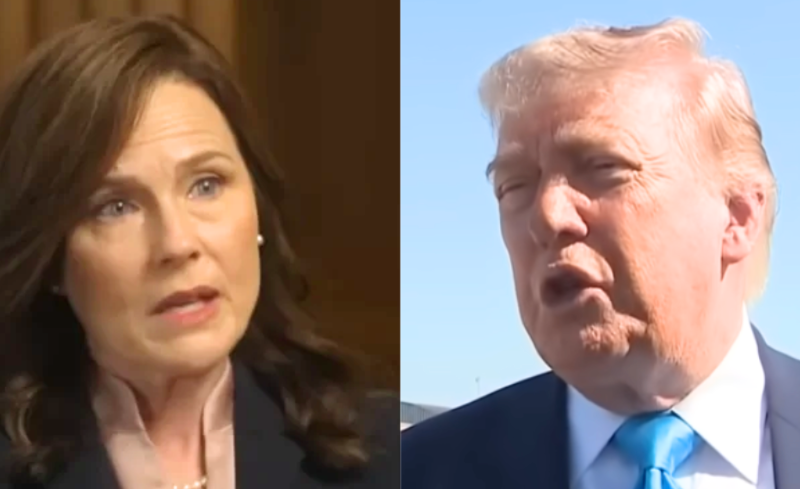
A Supreme Court justice hand-picked by President Donald Trump has become the most unlikely villain in conservative circles after writing the opinion that handed him one of his sharpest judicial defeats to date.
Justice Amy Coney Barrett, once celebrated as a crowning achievement of Trump’s first term, authored the majority opinion in a 5-4 decision that cleared the way for Mississippi to count mail-in ballots arriving as many as five days past Election Day — as long as they carry a pre-Election Day postmark.
Barrett did not write alone. Chief Justice John Roberts stood alongside her, as did the court’s three liberal members — Justices Sonia Sotomayor, Elena Kagan, and Ketanji Brown Jackson — forming a cross-ideological majority that sent shockwaves through Trump’s base.
The backlash from the right was immediate and ferocious.
Steve Bannon, never one to mince words, went straight for Barrett’s carefully cultivated conservative credentials on his War Room podcast, questioning whether anyone around Trump had done their homework before putting her on the bench.
“Amy Coney Barrett. Man, she was a lovely pick. Did anybody do any due diligence here? Right to life crowd, did you do your due diligence? Are you happy with what you got?” Bannon said.
Megyn Kelly delivered an even more surgical verdict, stripping Barrett of any remaining goodwill in four blunt words.
“Amy Coney Barrett is a turncoat, she’s constantly sitting with the left,” Kelly declared on her program.
Republican Senator Eric Schmitt piled on, calling the ruling “a shockingly wrong opinion” and condemning Barrett for aligning with “liberal justices” in a decision he argued “is terrible for election integrity.”
Trump himself made clear he was not pleased. He took to Truth Social to label the outcome “a tremendous loss,” then stepped before reporters in the Oval Office and called it “a little bit surprising,” adding that the ruling “gives people more time to vote illegally.”
Barrett, for her part, offered no apologies. Her opinion methodically dismantled the legal argument that federal election statutes override Mississippi’s rules on late-arriving absentee ballots.
“The election-day statutes do not set a deadline for ballot receipt, so they do not prevent Mississippi from counting ballots postmarked before election day yet received afterward,” she wrote.
Justice Samuel Alito was having none of it. His dissent reached back to the founding era to make the case that the majority had rewritten what Election Day has always meant in American law.
“From this Nation’s founding until the last few decades of the 20th century, a period that spans the enactment of all three election-day statutes, having an ‘election’ on a particular day meant completing ballot collection on that day,” Alito wrote.
Justices Clarence Thomas and Neil Gorsuch signed Alito’s dissent without reservation. Justice Brett Kavanaugh agreed with his conclusion and his fraud concerns but declined to endorse every strand of Alito’s legal argument.
The ruling lands at a particularly sensitive moment for the White House.
Trump has been pushing hard for the SAVE America Act, a sweeping elections overhaul that would require citizenship documentation to register and photo ID to vote — and would effectively eliminate mail voting for anyone outside of narrow exemptions covering the sick, disabled, traveling, and military-deployed.
Congressional gridlock over the bill has already claimed collateral damage. Trump refused to sign a bipartisan housing package — what would have been the first major reform to the housing market in roughly three decades — until lawmakers move on his election agenda.
Data complicates the fraud narrative driving that push. A Brookings Institution study released last November tracked an average of just four confirmed mail ballot fraud cases per 10 million votes over the last five federal elections. Trump himself submitted a mail ballot in a Florida special election earlier this year.
RNC Chairman Joe Gruters vowed the legal and legislative battle would continue, blasting Democrats for “inviting chaos at the ballot box by allowing elections to drag on for days and weeks after voters cast their ballots.”
Mississippi is far from alone in its policy. More than a dozen states — including Texas, Alaska, Nevada, Virginia, and California — permit mail ballots to be counted after polls close on Election Day.
California Governor Gavin Newsom celebrated the outcome on X. “This is a win for voters, plain and simple,” he posted. “Today’s ruling helps ensure mailed-in-ballots get counted and people’s voices are heard through the democratic process.”
