

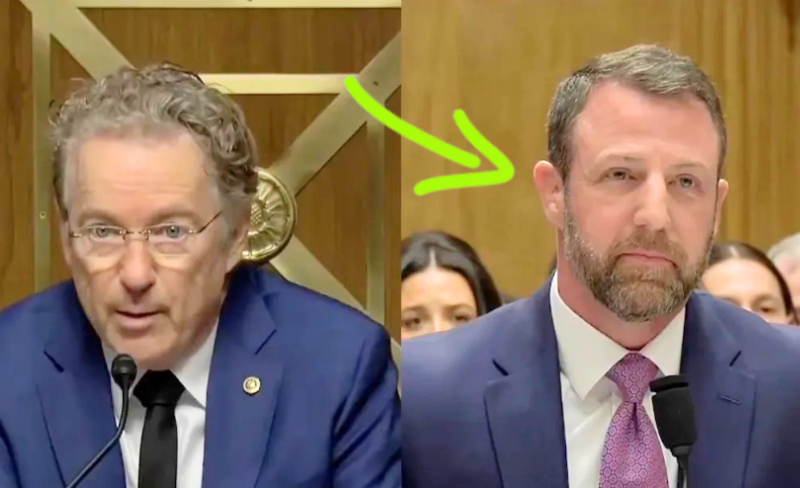
A visual overhaul is underway at the Department of Homeland Security, and its architect says the change reflects nothing less than the nation’s current state of conflict.
Secretary Markwayne Mullin delivered the announcement Sunday, sitting down with Fox News host Peter Doocy for “The Sunday Briefing.”
Rather than a minor cosmetic tweak, Mullin cast the redesign as a signal of how seriously his agency views today’s security climate.
Threat assessment, Mullin explained, dominates his daily schedule without pause.
“Every single day I get a briefing; every single day we have new threats, and every single day the threats are changing,” he said.
Adversaries rarely stay still after a setback, according to the secretary.
“Every time we stop a threat, a terrorist act, or a criminal activity that’s taken place, they also change their tactics,” Mullin said. “We have to be constantly moving from cyber to sea, to air, and to land. We are constantly moving.”
That relentless pace, Mullin indicated, is what pushed DHS toward altering one of its most recognizable emblems.
Federal seals traditionally show an eagle gazing toward a palm leaf, a nod to peacetime conditions. DHS is breaking from that convention entirely.
“We’re actually changing our seal to make it look towards the arrows because when it looks towards the arrows, it means we’re at war,” Mullin said.
The secretary connected the imagery shift to his agency’s broader posture.
“Homeland Security is at war every single day against bad actors trying to hurt our backyards, and we’re not going to allow that to happen,” Mullin said.
Historical roots run deep for this kind of iconography.
The design traces back to the Great Seal of the United States, which shows an eagle gripping an olive branch representing peace in one talon and 13 arrows symbolizing the founding states and military preparedness in the other.
Mullin didn’t stop at seal design during the sit-down.
He turned to naming specific nations posing active dangers, starting with Iran, which he described bluntly as run by a “murderous regime.”
Cybersecurity concerns took center stage next, with Mullin singling out Beijing as a persistent aggressor.
He pointed to Chinese-manufactured technology embedded in American infrastructure as a vulnerability being actively exploited.
“China has a tremendous amount of effort moving towards cyber attacks, because of all the technology they have shipped in to the United States with our infrastructure and the amount of intellectual property that they have stolen,” he said.
Russia received similarly pointed criticism for allegedly harboring cybercriminals with state knowledge and protection.
“Russia has bad actors that they allow to operate within their boundaries that are also protected, and they know about it,” Mullin said. “So it doesn’t stop. We have hundreds of thousands of attacks every week that’s coming against our critical infrastructure.”
Notably, this high-profile interview followed a frightening ordeal just days earlier.
Mullin had been a passenger aboard a Coast Guard plane when one of its engines gave out mid-flight, forcing an emergency landing.
Pilots safely guided the Gulfstream jet to Ronald Reagan Washington National Airport in Virginia, and officials confirmed no one aboard was hurt.
Fourteen passengers, Mullin included, made it through the incident unharmed.
Mullin later shared his account of the landing on social media platform X, singling out the flight crew for their composure under pressure.
“The United States Coast Guard pilots made the single engine landing feel routine,” he wrote. “No panic, just straight professionalism. After we landed, the pilots told me that was a first for them! We could not have been in better hands.”
According to the secretary’s own description, even the pilots acknowledged the rarity of the situation they had just handled.
His praise underscored the skill level he attributed to the Coast Guard aviation team.
Taken together, the seal redesign and the airborne emergency reflect a consequential week for the Homeland Security chief, marked by both symbolic policy decisions and a brush with real danger in the skies.
