

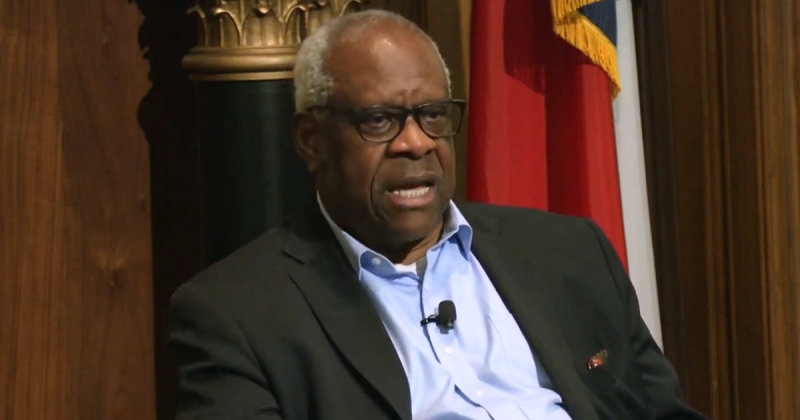
The Supreme Court is facing fresh internal tension after Justice Clarence Thomas, joined by Justice Samuel Alito, criticized the Court for stepping into a Florida death penalty case he argued involved a minor procedural issue while declining to hear other disputes he considers more consequential.
The dispute centers on Whitton v. Dixon, a long-running Florida murder case involving death row inmate Gary Whitton, who was convicted in 1991 for the killing of James Maulden, a friend prosecutors say was found stabbed multiple times in a motel room in 1990.
In a 7–2 ruling, the Court vacated a decision by the 11th U.S. Circuit Court of Appeals and ordered it to reconsider whether Whitton should receive a new trial.
The justices said the lower court improperly weighed DNA evidence that was not presented to the original jury when assessing whether false testimony affected the verdict.
That DNA evidence, developed years after the trial, indicated blood found on Whitton’s boots belonged to the victim.
Prosecutors have long argued the forensic record, combined with witness testimony and circumstantial evidence, overwhelmingly supported the conviction, according to Newsweek.
Whitton’s appeal focused on allegations under Giglio v. United States, claiming a jailhouse informant falsely testified that he had no prior criminal record when he told jurors Whitton confessed to the killing.
The prosecution acknowledged that statement was inaccurate but argued it was not material to the outcome given the broader evidence at trial.
Thomas sharply rejected the Court’s decision to intervene, calling the issue an “inconsequential foot fault” that had no meaningful impact on the case outcome.
“It is unfortunate that the Court chose to intervene at the request of a convicted murderer to correct the Eleventh Circuit’s inconsequential foot fault,” Thomas wrote in his dissent.
He further argued that the Court was misplacing its attention, pointing to other cases the justices have declined to hear—cases involving claims of racial discrimination in university admissions policies, free speech restrictions on campuses, and lawsuits brought by families of military personnel.
“What makes it even worse is that the Court does so even while it refuses to correct far more consequential errors for law-abiding citizens,” Thomas wrote, as highlighted by Fox News.
The majority, however, said the legal question was narrow: whether the appellate court improperly considered post-trial evidence when evaluating whether the alleged false testimony influenced the jury that actually decided the case.
Because the DNA evidence was not presented to that jury, the Court ruled it should not have factored into the appeals analysis and sent the case back for further review, Law & Crime reported.
Whitton, who has maintained his innocence in post-conviction proceedings, argued that false testimony from a jailhouse informant violated his constitutional rights.
The 11th Circuit previously upheld his conviction, citing what it described as “overwhelming evidence” of guilt, including physical evidence, witness accounts, and Whitton’s presence with the victim shortly before the murder.
According to court records, Whitton was last seen with Maulden on the night of the killing after the victim withdrew money from a bank account.
Prosecutors say Whitton later took Maulden to a motel, where he was killed. Whitton has disputed that account, claiming he discovered the body after the fact.
The Supreme Court’s decision does not grant Whitton a new trial but sends the case back to the 11th Circuit to reassess whether the alleged false testimony could have influenced the jury’s original verdict without considering later DNA testing.
Thomas warned the ruling would likely have little practical effect, suggesting the lower court could reach the same conclusion after minor revisions.
He also used his dissent to argue the Court inconsistently prioritizes cases, granting emergency relief in some matters while declining review in others involving broader civil rights questions.
Alito joined Thomas’s dissent in part, though he did not sign onto all of his broader criticisms of unrelated cases.
The case now returns to the lower court for further proceedings, while the broader dispute highlights continuing divisions on the Court over when intervention is warranted—and what types of cases deserve the justices’ attention.
