

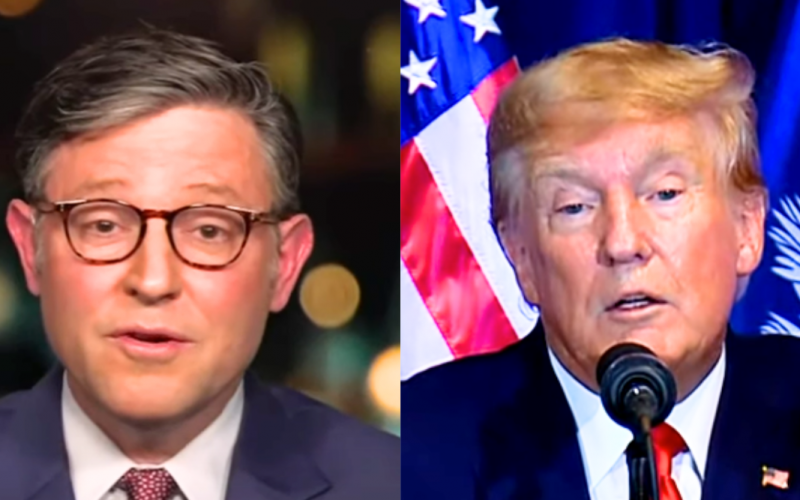
A high-stakes standoff over voter identification requirements has pushed House Republican leadership to deploy an unusual legislative tactic this week, one designed to force the Senate’s hand on a citizenship-verification voting bill that has stalled for months.
Conservative lawmakers effectively paralyzed House floor activity, blocking procedural votes until leadership committed to a tougher strategy for advancing the measure known as the SAVE America Act.
That bill requires anyone registering to vote in federal elections to prove U.S. citizenship and mandates that voters show identification at the polls before casting a ballot.
Facing internal pressure, Speaker Mike Johnson responded by announcing a plan to fuse the election bill with the National Defense Authorization Act, the annual must-pass legislation that funds the military and cannot realistically be voted down.
Johnson unveiled the tactic to reporters Monday, invoking a term more commonly associated with missile technology than legislative procedure.
He explained that House Republicans would use what’s called “MIRVing” — attaching multiple measures to a single rule vote so they travel together to the Senate.
“We’re going to pass a MIRV, or what’s better known as a merge onto the rule,” Johnson said.
Under this approach, a single vote on the rule would simultaneously lock in support for the defense bill and the SAVE America Act, which the House already approved back in February.
“So what that means is, when Republicans vote for the rule, they’ll be voting not just for the NDAA and everything else is there, but they’ll be voting to merge onto that the SAVE America Act we passed back in February,” Johnson said.
The Speaker argued the tactic would put wavering Republicans on the spot, since opposing the rule would mean voting against sending both bills to the Senate together.
“So that will send both of those items together over to the Senate, and so if any Republicans choose to vote against the rule, they will be voting against that outcome. So we think this is another good way to show the resolve of the House,” Johnson said.
Even so, the plan does nothing to stop the Senate from later splitting the two bills apart and passing the defense authorization without the voting provisions attached.
That loophole has become a flashpoint among House conservatives, several of whom believe Johnson’s strategy is little more than a symbolic gesture.
Florida Congresswoman Anna Paulina Luna emerged as the sharpest critic, blasting the plan on social media as insufficient to guarantee results.
“‘MIRVing’ the NDAA plus either SAVE America or Voter I.D. would still allow the Senate to strip out either or,” Luna wrote on X.
She insisted that true protection for the bill requires writing it directly into the NDAA’s actual text, not merely pairing the two pieces of legislation procedurally.
“The only way to ensure the Senate passes this is to make sure it’s in the bill text of the NDAA, meaning that my amendment(s) must be made an order,” she wrote.
Luna defended her refusal to back down, framing her position as aligned with overwhelming public demand for stricter voting laws.
“I’m not trying to be difficult, but this is what 80% of Americans want and what we promised the American people, so I stand by my decision,” she said.
Beyond the intraparty friction, Johnson’s maneuver sets up a fresh confrontation with Democrats, who have long opposed the SAVE America Act and are widely expected to vote against the defense bill if the election measure stays attached.
Democratic lawmakers have characterized the citizenship and ID requirements as obstacles to voting access, while Republicans continue to defend the measure as a necessary safeguard against non-citizens influencing federal elections.
Adding another wrinkle, the House-passed bill does not currently restrict mail-in voting, a reform President Donald Trump has repeatedly pushed as a top priority.
Not all conservatives have rejected Johnson’s plan outright. Tennessee Rep. Tim Burchett said he’s withholding judgment until he sees the actual legislative language.
“We might be able to get everything we want, but as Luna said, we’d need to see it on paper first,” Burchett told reporters.
House Freedom Caucus Chairman Andy Harris struck a more supportive tone, signaling he’ll back nearly any path that keeps the election bill alive.
“Any way to include the SAVE or SAVE America Act on everything coming out of the House, I’m for,” Harris said, according to The Hill.
Whether Johnson’s gambit succeeds now depends on whether he can hold his conference together long enough to survive a near-certain fight in the Senate.
