

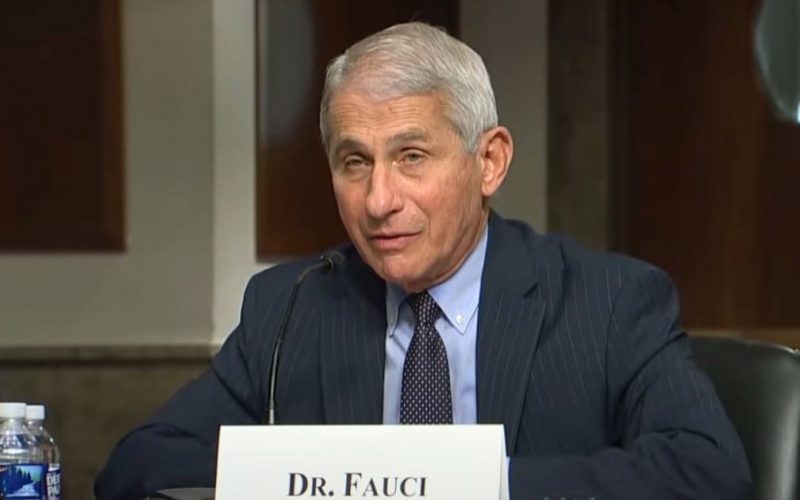
Senate Republicans are no longer presenting a united front on Anthony Fauci. While Sen. Rand Paul accelerates plans to force a criminal referral, two of his GOP colleagues are publicly pumping the brakes.
Paul, R-Ky., declared Tuesday that he has counted enough support to hold the former White House COVID adviser in contempt of Congress.
His confidence stems from Fauci’s decision to repeatedly plead the Fifth Amendment during recent congressional questioning.
Paul is now eyeing a faster route than tradition allows. Instead of waiting on a full Senate floor vote, which demands a 60-vote threshold to succeed, he may send the contempt referral straight to the Justice Department himself.
Backing him is Sen. Josh Hawley, whose office is already putting together a legal brief for acting Attorney General Todd Blanche. The memo makes the case that Fauci is a viable target for prosecution.
“My team is working right now on a memo to Blanche explaining why we think that he can be prosecuted for contempt of Congress,” Hawley told Fox News Digital.
Hawley framed the issue as a matter of legal contradiction, insisting Fauci cannot lean on two conflicting protections simultaneously.
“He’s not entitled to immunity, taken the Fifth, when he already has a pardon. It’s one or the other,” Hawley said.
Momentum built last Thursday when the Senate Homeland Security and Governmental Affairs Committee voted to advance a contempt resolution against Fauci.
Standard Senate rules call for that measure to head next to the full chamber for a vote.
That’s exactly where Sen. James Lankford believes it should stay. He cautioned that shortcutting the process now could haunt Republicans later.
“It’s got to actually go through the full Senate,” Lankford said. “That’s the challenge.”
Paul’s workaround hinges on Vice President JD Vance, who holds the constitutional role of Senate president.
Under this plan, Vance would personally certify the contempt resolution and hand it off to the U.S. attorney overseeing the District of Columbia.
Lankford flagged a long-term risk in that maneuver, warning it could hand future Democrat majorities a tool to use against conservatives.
“The vice president would have to make a decision if he wants to try to change the structure of what has been done in the Senate, because then that would make them vulnerable three years from now to a future, maybe, Democrat Senate,” Lankford said.
A separate objection came from Sen. Mike Rounds, who questioned whether the legal groundwork for contempt even holds up.
“The first thing you have to do is identify what it is that you would be holding him in contempt for,” Rounds said. “I think he took the Fifth. And doing so, I think it makes it more difficult for anybody to actually suggest that.”
Rounds also pushed back against rushing judgment on Fauci’s pandemic-era conduct, pointing to the confusion that defined the crisis’s opening months.
“Whether the advice was really good advice or if it was the best advice they had, it was a different time period,” Rounds said. “So I just hope we all remember that.”
These internal objections land at a politically sensitive moment, as grassroots conservatives keep pressing for answers on Fauci’s pandemic decisions, his testimony record, and the still-unresolved origins of COVID-19.
Not every Republican is hesitant, though. Sen. Ashley Moody has aligned herself with Paul, arguing the courts are the proper venue to finally settle whether Fauci’s Fifth Amendment claim holds water.
“I think Rand Paul feels very strongly that you can’t have him coming in and pleading the Fifth in this situation,” Moody said.
She suggested litigation may be unavoidable regardless of what the Senate decides.
“I think he also believes ultimately this will wind up in a court and that will be clarified by a court, and I think that’s probably necessary as we move forward,” Moody said.
Fueling the entire fight is the broad pardon President Joe Biden granted Fauci before leaving office, shielding actions taken between Jan. 1, 2014, and Jan. 19, 2025.
That pardon now sits at the center of the legal question: can someone already protected from prosecution still legitimately fear self-incrimination before Congress?
Paul shows no sign of retreating. His pressure campaign leaves Vice President Vance and the Justice Department staring down a defining choice — one that will determine whether Fauci’s pardon and his silence before lawmakers place him permanently out of reach.
