

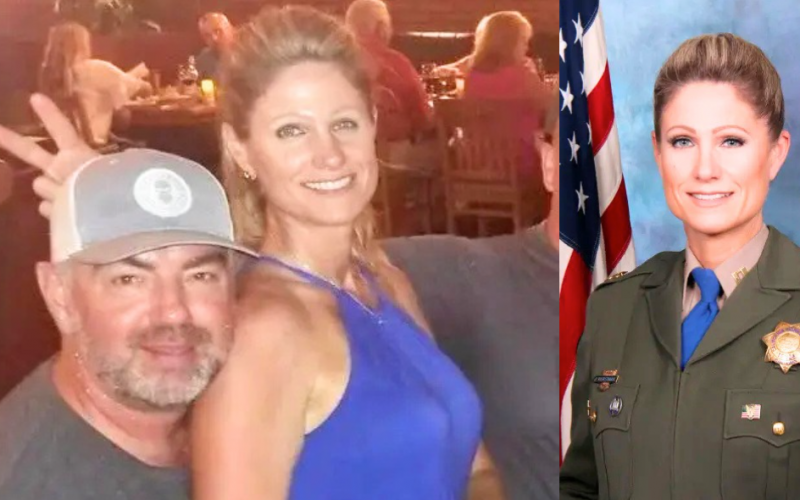
A Napa Valley man learned his fate Friday inside a Kentucky courtroom, convicted of murder after a jury needed barely two hours to decide he had traveled across the country and gunned down a man lured to an empty house under false pretenses.
Thomas O’Donnell, 64, was found guilty of killing Michael Harding in what prosecutors described as a calculated, pay-to-kill arrangement orchestrated by the victim’s own wife.
The woman at the center of the scheme, Julie Harding, never faced trial. The former California Highway Patrol captain died by suicide in the months following her estranged husband’s death, taking whatever she knew to the grave.
What she left behind, however, was a digital footprint — and it proved devastating in court.
Federal investigators pieced together a timeline built almost entirely on cellphone data, tracing the movements of O’Donnell’s personal device alongside a second, prepaid phone that prosecutors argued he carried specifically for the operation.
The prepaid number, untraceable by design, logged three separate trips to Celina, Tennessee — the town where Michael Harding called home.
Two days before the murder, O’Donnell’s phone registered near Julie Harding’s Sacramento residence at the same hour her own device showed her present at that location. Prosecutors told jurors that was the moment the deal was struck.
On September 19, 2022, Michael Harding drove toward a vacant property on Glasgow Road in Burkesville, Kentucky, believing he had been called out for an HVAC repair job. He never left.
The text messages exchanged in the final minutes of his life were read aloud to the jury by FBI Special Agent Elizabeth Wheeler. At 4:10 p.m., Michael messaged the prepaid phone announcing he was thirty-five minutes away. The response came back casual, unhurried: “No worries.”
He followed up, asking whether his arrival time worked. The prepaid phone confirmed it did.
His last message was three words: “See ya soon.”
The reply, sent at 4:16 p.m., was a single word: “Perfect.”
Investigators subsequently confirmed through FBI location data that the prepaid phone and O’Donnell’s personal device traveled in tandem throughout the entire episode — including to Celina and to the Burkesville crime scene.
Prosecutors acknowledged gaps in the physical evidence. No firearm was recovered. The prepaid phone was never found. A key fob connected to the case remains missing.
DNA and ammunition evidence were presented, but the murder weapon itself never materialized.
The defense seized on those absences. Attorneys argued that phone records demonstrate only where a device traveled, not the identity of whoever was holding it, and that no financial transfer between Julie Harding and O’Donnell was ever documented.
Defense attorney Sara Zeurcher urged the jury to consider that a third, unnamed man may have been the actual shooter.
“Julie came up with a plan involving another man and Tom,” she told the panel. “Tom was involved with this plan but did not intend for this result to happen. There has been no proof he had any idea that Michael Harding would be murdered.”
Prosecutor Jesse Stockton was unmoved. Standing before the jury in his closing argument, he was blunt: “There’s no evidence someone else killed him. All this evidence points to this amateur hitman from California. Do your duty. Find him guilty of murder.”
The jury obliged in roughly two hours.
Julie Harding had reportedly told colleagues she and O’Donnell were involved romantically. The murder unfolded as she and Michael Harding were navigating a bitter divorce, according to KCRA 3.
Her phone, records showed, remained in Sacramento on the day her husband was shot dead in Kentucky.
O’Donnell is scheduled to appear for sentencing Monday, where he faces a minimum of 20 years and a maximum of life behind bars.
