

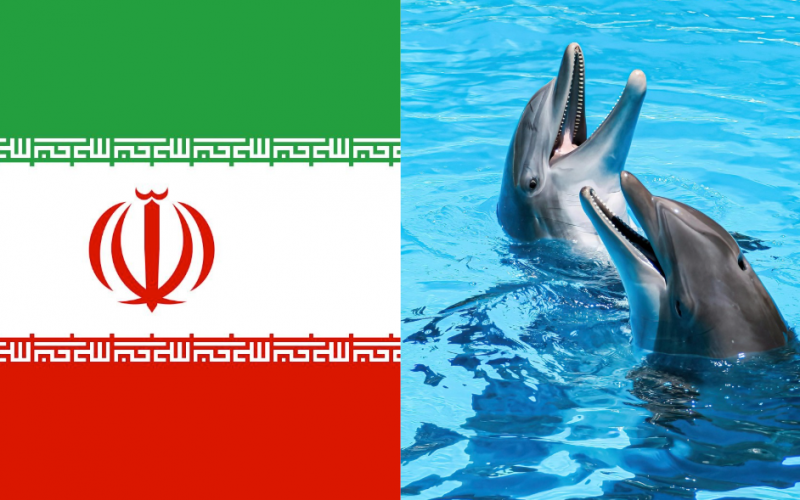
Deep inside the Iranian military’s strategic arsenal sits a weapon that most Americans would not believe exists: combat dolphins, purchased from the collapsed Soviet Union a quarter-century ago, trained to carry mines directly into the hulls of enemy warships.
According to Iranian officials cited by the Wall Street Journal, those dolphins are now back on the table.
The disclosure surfaced amid a weeks-long US military blockade that has sealed off Iran’s oil exports through the Strait of Hormuz — a chokepoint so economically vital that its closure has sent shockwaves through the Islamic Republic’s finances.
A ceasefire between Washington and Tehran technically remains in place. But inside Iran, that distinction is becoming harder to sell.
A bloc of hardline military and political figures has concluded that the export ban constitutes an act of war in everything but name, and they are pressing Iran’s leadership to answer it with force — potentially including weapons that have never been deployed.
The dolphin program is one of them. Iran acquired the animals from the former Soviet navy in 2000, as first reported by the BBC.
The Soviets had spent years conditioning marine mammals for military operations, and the dolphins Iran obtained had been trained for two distinct kill missions.
The first involved harpoons strapped to the animals’ backs, designed to drive the weapon into a human target underwater. The second was a suicide strike: the dolphin, carrying a mine, would ram an enemy vessel and detonate on impact.
It is that second capability — the kamikaze strike — that Iranian officials are now reportedly reconsidering as a potential tool against US Navy ships stationed in the region.
The dolphins are not Iran’s only unconventional card. The Wall Street Journal reported that Tehran is also weighing submarine deployments into the strait, a move that would dramatically raise the stakes of any confrontation with American forces.
The Islamic Revolutionary Guard Corps has gone further still, threatening to cut undersea communication cables running beneath the Strait of Hormuz. Severing those lines would not merely inconvenience Iran’s adversaries — it could ripple across global internet infrastructure.
On the geopolitical front, Iran’s efforts to extract economic leverage from the blockade have run into resistance. Gulf nations have aligned with the United States, effectively collapsing Tehran’s earlier scheme to impose transit tolls on shipping passing through the waterway.
“Iranian decision makers may soon come to see renewed conflict as less costly than continuing to endure a prolonged blockade.”
The Trump administration, meanwhile, has shown no signs of softening its position.
President Trump has publicly praised the blockade’s design and directed aides to prepare for an extended enforcement campaign, framing the economic stranglehold as the price Iran must pay before any return to the negotiating table.
The Islamic Revolutionary Guard has tightened its internal grip as well, having pushed aside moderate factions within Iran’s power structure — a shift analysts say has accelerated the country’s drift toward confrontation rather than compromise.
Hamidreza Azizi, a visiting fellow at SWP, a Berlin-based research institute focused on the Middle East, gave the Wall Street Journal a stark assessment of where Iranian thinking currently stands.
“The blockade is increasingly viewed in Tehran not as a substitute for war, but as a different manifestation of it. As a result, Iranian decision makers may soon come to see renewed conflict as less costly than continuing to endure a prolonged blockade.”
Azizi’s framing captures a critical shift: Iran is no longer calculating whether to endure the blockade. It is calculating whether the cost of fighting back has finally dropped below the cost of standing down.
The Strait of Hormuz — roughly 21 miles wide at its narrowest — is the transit corridor for a substantial portion of global oil. A military exchange there, conventional or otherwise, would carry consequences well beyond the Persian Gulf.
Whether Iran moves forward with any of these measures remains unconfirmed. What is clear is that the options being discussed — submarines, severed cables, and Cold War–era suicide dolphins — signal a regime that believes it is already in a war, regardless of what the ceasefire papers say.
