

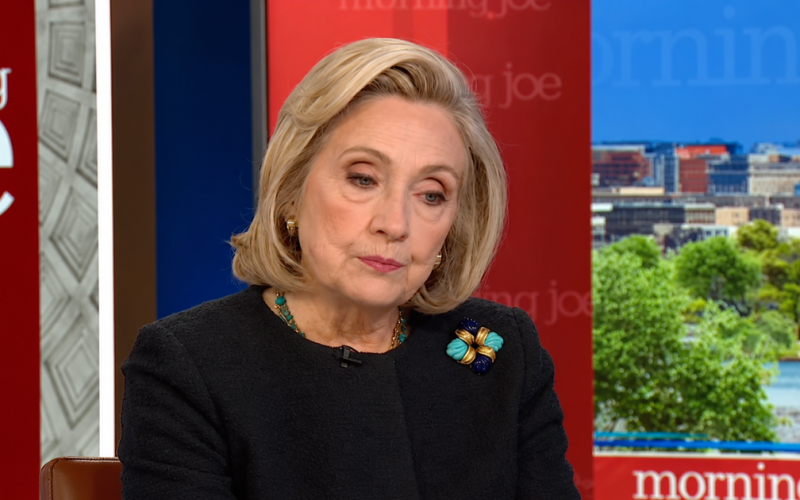
President Donald Trump is asking the U.S. Supreme Court to revive his dismissed lawsuit against Hillary Clinton and several other political opponents tied to allegations surrounding the 2016 election.
Trump filed an appeal Friday, October 9, seeking to overturn lower court decisions that dismissed the case and imposed nearly $1 million in sanctions against him and attorney Alina Habba.
The lawsuit was originally filed in 2022 and accused Clinton, the Democratic National Committee, former FBI Director James Comey, former British intelligence officer Christopher Steele and others of working together to damage Trump politically by promoting allegations linking his campaign to Russia.
Trump’s attorneys now argue that the lower courts improperly punished him and his lawyers for pursuing what they maintain were legitimate legal claims.
In the filing, they accused federal courts of showing “a deeply troubling trend” of using sanctions and disciplinary threats against Trump and attorneys who represent him.
They argued that Supreme Court intervention is needed to prevent judges from punishing lawyers simply because they disagree with the legal theories being advanced.
Trump originally filed the lawsuit in federal court in Florida in March 2022.
U.S. District Judge Donald Middlebrooks dismissed the case later that year, finding that multiple claims were legally deficient.
Some of the allegations were deemed untimely, while others failed to establish sufficient grounds for relief.
Middlebrooks later imposed nearly $1 million in sanctions against Trump and Habba in January 2023.
The judge concluded that the lawsuit relied on unsupported factual allegations and weak legal arguments.
He also accused Trump and his attorneys of using the court system to advance a political narrative.
Trump and Habba rejected that characterization and maintained that the litigation raised legitimate questions about the conduct of Clinton and other defendants.
At the center of the lawsuit were claims that Clinton and her allies promoted a false narrative suggesting that Trump’s 2016 presidential campaign improperly coordinated with the Russian government.
The complaint included allegations involving racketeering, conspiracy and other misconduct.
Trump argued that the alleged actions damaged his reputation and interfered with his political activities.
The lawsuit also focused heavily on the Steele dossier.
The dossier contained a series of allegations about Trump and Russia and was compiled during the 2016 campaign by Steele while working for a research firm hired through a law firm representing the Clinton campaign and the Democratic National Committee, per the Conservative Brief.
Several major allegations contained in the dossier were never corroborated, while others were later discredited.
Trump eventually appealed the dismissal to the 11th U.S. Circuit Court of Appeals.
In November 2025, a three-judge panel largely upheld the district court’s decisions.
The appeals court concluded that Trump’s racketeering claims were filed too late and lacked sufficient legal merit.
The panel also upheld the sanctions against Trump and his attorneys and described many of their legal arguments as frivolous.
The appeals court did make one limited correction involving a British intelligence company.
It ruled that claims against that defendant should have been dismissed without prejudice because the lower court lacked personal jurisdiction.
That decision did not revive the broader case against Clinton and the other defendants.
One member of the appeals panel, Judge Andrew Brasher, was appointed by Trump during his first term.
Trump’s attorneys are now asking the Supreme Court to reconsider both the dismissal and the sanctions.
They argue that the courts wrongly rejected Trump’s explanation for waiting until 2022 to file the lawsuit.
According to the appeal, Trump delayed taking legal action during his first presidential term because his constitutional responsibilities occupied his time.
His attorneys contend that the statute of limitations should therefore have been extended.
They are also challenging the sanctions on broader constitutional grounds.
Trump’s legal team argues that allowing judges to impose large financial penalties against a president and his attorneys for disputed legal arguments could discourage future litigation involving presidential interests.
“This court’s intervention is necessary to protect the presidency, and to prevent judicial disagreement from becoming a license to punish its advocates,” the attorneys wrote.
The Supreme Court has not yet indicated whether it will agree to hear the case.
