

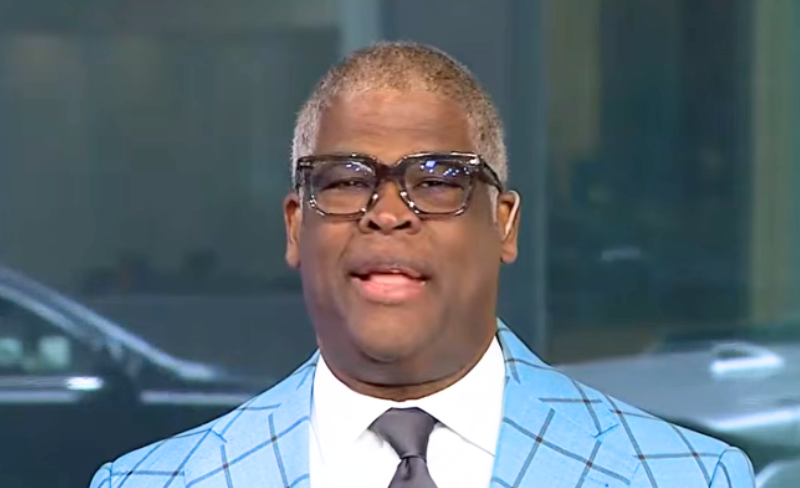
A wave of gun violence in Harlem struck close to home for a national television personality this week, even as fresh government data revealed America’s streets are safer than they’ve been in generations.
Charles Payne, a host on Fox Business, used a live broadcast to share that a relative had become a victim of gun violence in the same New York neighborhood where he came of age.
The anchor’s voice carried the weight of personal loss as he addressed his co-hosts on air.
According to Payne, his niece had gone to Harlem for a somber purpose: honoring the memory of a friend’s late son at a memorial gathering.
Investigators believe she was not the intended target but was instead struck during a shooting aimed at other people in the area.
“My niece was shot on the street that I grew up on,” Payne told viewers, tying the tragedy directly to his own upbringing in the neighborhood.
Surgery lasting four hours followed the shooting, Payne revealed. He told his co-hosts that his niece has since begun the road to recovery.
“She’s okay now,” Payne said, delivering a note of relief amid the difficult disclosure.
The anchor didn’t stop at recounting the incident.
He connected it to a larger pattern he believes has gone largely unnoticed by media outlets: an entrenched gang presence spreading through American communities regardless of their economic profile.
“Whether it’s in places where the opioid epidemic is out of control or places like my neighborhood was being gentrified, but this gang thing has really been amazing.
I had no idea it was getting, it was this bad. It’s really bad,” Payne said.
Payne then made a pointed claim linking the gang violence to immigration enforcement failures.
“These illegal immigrants are gangsters,” he said. “They’re all intertwined in these gangs. No one will report on it, but it’s because it’s really bad.”
While one family grappled with tragedy, newly published federal statistics painted a starkly different national picture.
The FBI’s latest figures show violent crime across the country fell by 9.3 percent from 2024 into 2025 — the sharpest single-year drop since the agency began tracking such data in 1936.
Individual crime categories showed even steeper declines.
Killings and non-negligent manslaughter cases sank 18.1 percent nationwide, and robberies fell 18.5 percent.
Rape reports dropped 7.6 percent, while aggravated assaults decreased 7.2 percent over the same period.
America’s murder rate has now fallen to roughly 4.1 per 100,000 residents, a level unseen since the 1950s.
Property crimes told a similar story, tumbling 12.4 percent as burglaries, car thefts, and larceny cases all retreated sharply.
This turnaround comes after a turbulent stretch earlier in the decade, when riots, demonstrations against police, and heated debates over criminal justice reform gripped the nation’s attention.
Public anxiety over crime became a defining political issue during that period.
President Donald Trump has placed law-and-order policies at the center of his administration’s agenda since taking office.
Congressional Republicans have echoed that focus, championing harsher sentencing for violent criminals, increased funding for police departments, and tighter collaboration between federal and local law enforcement agencies.
FBI Director Kash Patel publicly praised the nation’s police forces for the dramatic turnaround, stating that law enforcement agencies had “delivered for the American people.”
Preliminary data suggests the positive trend has carried into 2026, though analysts urge caution before drawing sweeping conclusions.
The current 2026 numbers stem from a sample of cities rather than a complete national dataset compiled by the FBI.
Experts have specifically warned against crediting any one political figure, administration, or law enforcement strategy for the widespread declines, noting the sheer diversity of communities contributing to the trend.
Not every metric moved favorably. Domestic violence reports and sexual assault cases climbed in some cities included in the 2026 sample, complicating an otherwise positive narrative.
Even with those exceptions, the overall direction of the data remains unmistakably positive, reflecting years of public pressure for stronger protections for neighborhoods, businesses, and police officers alike.
Together, Payne’s personal account and the national statistics illustrate the complicated, uneven reality of crime in America today — one marked by historic overall progress alongside individual stories of continued violence.
