

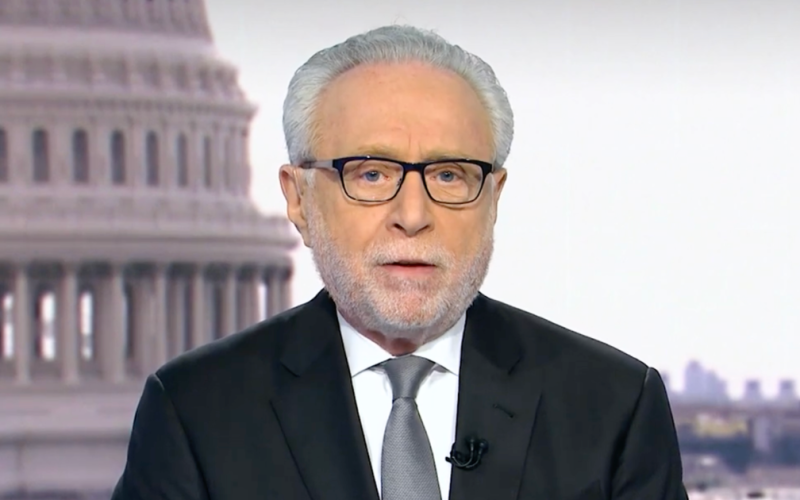
CNN anchor Wolf Blitzer issued an on-air correction after suggesting that President Donald Trump’s new mail-in voting rules could affect ballots cast by US military personnel serving overseas.
The correction came Monday on “The Situation Room,” days after Blitzer discussed the Trump administration’s March executive order and legal challenges seeking to block its implementation.
“We discussed legal challenges to the Trump administration’s directives for the Postal Service on mail-in voting,” Blitzer told viewers.
Blitzer acknowledged that a previous comment he made suggested ballots belonging to US military personnel and other Americans overseas would be affected by the directives.
“I want to be clear right now: those ballots are exempt from the Postal Service’s new rules implementing the president’s March executive order,” Blitzer said.
“Those groups are covered under the Uniformed and Overseas Absentee Voting Act, just to be specific on that point,” he added.
The original exchange occurred Friday when Blitzer interviewed Virginia Gov. Abigail Spanberger about a lawsuit filed by Virginia and other states challenging Trump’s order.
A federal judge had issued a 14-day temporary restraining order blocking implementation the previous week.
During the interview, Spanberger accused the Trump administration of attempting to create fear surrounding mail-in voting.
“The continued attacks that we’re seeing from the Trump administration is really just an effort to get people fearful, to get people to stay home,” Spanberger said.
She further argued that the administration was targeting what she described as a “valid, safe, secure way” for Americans to cast their ballots.
Blitzer then brought up military personnel in Virginia who vote by mail while serving away from home.
“And in Virginia, you have a lot of military personnel who totally rely on mail-in ballots if they want to be able to express their opinions,” the longtime CNN anchor said.
Spanberger agreed, pointing to members of the military, diplomatic service, intelligence community and other Americans serving overseas who receive ballots at their postings around the world.
The problem with the exchange was that the Trump administration’s new Postal Service requirements do not apply to the military and overseas ballots Blitzer and Spanberger were discussing.
Those voters are instead protected under the Uniformed and Overseas Citizens Absentee Voting Act, or UOCAVA.
The federal law establishes absentee voting procedures for members of the uniformed services, qualifying family members and US citizens residing outside the country.
Trump signed the executive order, titled “Ensuring Citizenship Verification and Integrity in Federal Elections,” on March 31.
Among its provisions, the order directs the Department of Homeland Security, working alongside the Social Security Administration, to compile state-by-state lists of confirmed US citizens who will be at least 18 years old by the next federal election.
The order also directs the US Postal Service to establish rules governing mail-in and absentee ballots in federal elections.
Those requirements include official election-mail envelopes equipped with tracking barcodes and generally restrict USPS transmission of affected ballots to voters included on participation lists submitted by states.
States seeking to use the Postal Service for those ballots are directed to notify the agency and provide the corresponding lists.
The Postal Service subsequently issued a rule implementing the ballot-mail requirements.
Crucially, however, neither that rule nor the relevant mail-handling provisions apply to ballots protected by UOCAVA.
Congressional Research Service material summarizing the rule similarly states that military and overseas ballots covered under UOCAVA fall outside its scope and will not be directly affected, per Trending Politics.
Service members and other eligible Americans overseas can therefore continue using the existing UOCAVA system, including the Federal Post Card Application and established absentee-voting procedures.
Blitzer’s Monday statement formally corrected the impression left by Friday’s discussion, making clear to viewers that Trump’s new Postal Service rules do not change the absentee-ballot process for US troops and other UOCAVA-protected voters overseas.
