

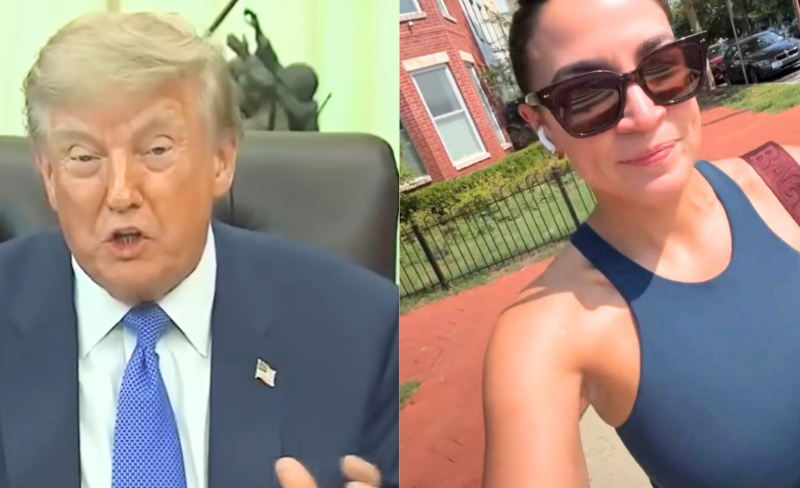
A presidential prediction from Donald Trump is sending shockwaves through political circles, with the sitting president naming Rep. Alexandria Ocasio-Cortez as a future contender for the Oval Office.
Fox News correspondent Alexis McAdams posed the question directly to Trump during a sit-down interview while the president traveled through Long Island.
Asked point-blank if Ocasio-Cortez would launch a 2028 campaign, Trump gave a short, confident answer.
“I think so,” he said.
Speculation about the congresswoman’s ambitions has intensified in recent weeks.
At 36 years old, Ocasio-Cortez made headlines after freezing her eggs, a personal decision that political insiders quickly tied to long-range career planning rather than short-term concerns.
Trump used the moment to draw a wider comparison, framing Ocasio-Cortez as one of several progressive figures now working to rewrite their public image after years of embracing hardline positions.
The congresswoman, a founding face of the group nicknamed “the Squad,” has recently taken steps to separate herself from the movement’s most aggressive chapter.
In a Sunday statement, she admitted that “woke 1.0 was crazy,” a remark widely interpreted as an attempt to shed associations with calls to defund police departments, loosen border restrictions, and ease criminal penalties.
Trump wasn’t buying the reinvention.
“But if you really look at it, they’re all saying the same thing. They’re all trying to disavow themselves from saying about crime and all, we love sanctuary cities. All of the things that they said they’re now trying to disavow,” he told Fox News.
Sanctuary city policy became a central target of the president’s critique.
These jurisdictions, which limit local cooperation with federal immigration authorities, have been tied by critics to preventable crimes committed by individuals living in the country illegally.
“I think you’re going to see sanctuary cities start to end, because sanctuary cities are a disaster. And somebody like her, she was big for sanctuary cities,” Trump said.
That claim lines up with concrete administration action.
Federal immigration enforcement has intensified under Trump’s second term, producing record deportation numbers and renewed pressure campaigns against local governments that continue shielding illegal immigrants from federal agents.
Support for sanctuary status, once a rallying point at progressive events, now carries political risk for candidates outside solidly Democratic territory.
Ocasio-Cortez isn’t alone in facing this kind of reckoning.
Trump turned his attention to Michigan Senate candidate Abdul El-Sayed, criticizing past comments in which El-Sayed linked football to “toxic masculinity,” colonialism, and slavery.
“Well, it’s a great place when you have Michigan – it’s a great bad place to be saying it,” Trump remarked.
He elaborated further, pointing to the sport’s deep roots in the state.
“They have a great football team, and the number of great football teams up there that the people love. I would say that that’s a big mistake,” Trump said.
Michigan’s football culture runs deep across both college and professional levels, making El-Sayed’s earlier remarks a potential liability in a state where the sport carries significant cultural weight.
Trump’s broader argument centers on a consistent theme: progressive politicians who once championed defunding police, treating immigration enforcement as optional, and elevating identity politics are now backpedaling as those same positions turn into political baggage.
Rising crime rates in major cities, extended school shutdowns, and strained public resources tied to unmanaged illegal immigration have shifted public opinion.
Ocasio-Cortez’s own rise to national prominence was built on embracing many of these exact positions.
She pushed to abolish Immigration and Customs Enforcement, backed the Green New Deal’s far-reaching economic overhaul, and expressed support for the unrest that gripped American cities in 2020.
Her recent effort to distance herself from that earlier era stands in sharp contrast to the record she built during it.
According to Trump, any future presidential run would force Ocasio-Cortez to account for years of statements and legislative votes that fall well outside mainstream political opinion.
The president also framed his own administration’s approach as a direct counterpoint to progressive policy experiments.
Where Ocasio-Cortez and allied Democrats once promoted sanctuary cities as a moral stance, Trump has moved aggressively to unwind them.
Where some Democrats treated football and traditional masculinity as cultural problems, Trump has positioned both as sources of national pride.
No formal timeline has been set for a potential Ocasio-Cortez campaign announcement, but Trump’s remarks add fresh fuel to speculation already swirling around her long-term political trajectory.
