

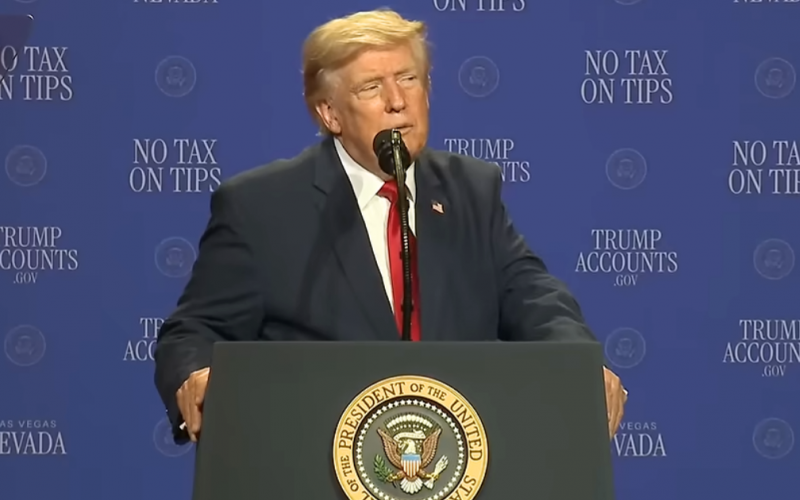
President Donald Trump signed two executive orders Thursday aimed at restricting automatic U.S. citizenship for certain children born in the United States, including those linked to what the administration calls “birth tourism.”
The orders mark the administration’s latest effort to challenge longstanding interpretations of birthright citizenship after the Supreme Court recently limited the use of nationwide injunctions blocking Trump’s earlier attempt to change citizenship rules.
The ruling limited the administration’s ability to enforce its broader order while leaving the underlying constitutional debate over the 14th Amendment’s Citizenship Clause to continue.
One executive order directs agencies to pursue policies that would prevent certain children linked to birth tourism arrangements from automatically receiving U.S. citizenship, according to the White House.
The administration defines birth tourism as individuals entering the United States while claiming to be visitors but intending to give birth so their child receives U.S. citizenship. Officials argue the practice has created an industry that exploits immigration laws.
The order also seeks to address commercial birth tourism operations involving paid arrangements, including cases involving surrogate mothers.
“This has been something that people have talked about not only for years, but for decades,” White House Deputy Chief of Staff Stephen Miller said. “The idea that people come here, pretend to be a tourist, pretend to be a visitor … but the real reason they’re here is to have a child, to make that child an automatic citizen.”
A second executive order directs the State Department and Department of Homeland Security (DHS) to develop additional policies aimed at stopping birth tourism operations both domestically and overseas.
Trump said the move came after what he called a “very unfortunate decision” from the Supreme Court regarding his earlier birthright citizenship order.
“People are building businesses around it,” Trump said. “That’s not the way it was supposed to work. It’s a disgrace. They’re buying their way in, and we’re not going to let it happen.”
The first order also seeks to identify additional categories of children the administration argues are outside the protections of birthright citizenship, including children of certain foreign government personnel and individuals designated as “alien enemies,” according to the White House.
The administration also argues the restrictions could apply to children whose parents engage in fraudulent activity or commercial transactions intended to obtain citizenship.
However, the effort is expected to face legal challenges from immigration advocates and civil rights groups, who argue the Constitution’s 14th Amendment guarantees citizenship to nearly everyone born on U.S. soil, according to Newsmax.
Legal experts have questioned how easily the administration’s birth tourism order could be enforced, particularly when determining a parent’s intent before entering the United States.
Kevin R. Johnson, a University of California, Davis law professor specializing in immigration law, said the orders are likely to face court challenges and raised questions about how officials would determine whether someone entered the country specifically to give birth.
“Discerning intent of a parent is challenging and open to abuse,” Johnson told The National News Desk.
The administration maintains that the new orders take a narrower approach by targeting categories it argues have historically been excluded from birthright citizenship protections.
WATCH:
