

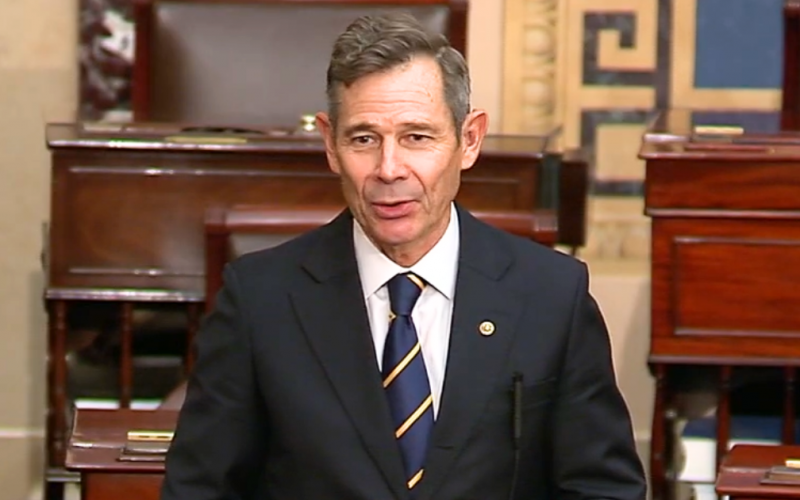
Utah Sen. John Curtis (R) introduced a bipartisan immigration bill that would allow states to create their own worker visa programs, but critics say a provision that could allow some illegal aliens to obtain legal status amounts to amnesty.
The bill, introduced Monday with Arizona Sen. Mark Kelly (D), would establish a state-sponsored visa program allowing states to request workers based on local labor needs.
Curtis said the proposal was designed to help businesses, farmers, and ranchers facing worker shortages while maintaining federal oversight, background checks, and accountability measures.
“Our legislation would help fill the gap by creating a pilot program allowing states to sponsor visas tailored to their unique economies,” Curtis said in a statement.
Kelly said states understand their own workforce needs but are currently limited by federal immigration rules.
Under the legislation, states could create programs for individuals coming to work or invest in the United States, along with their spouses and minor children, according to the Deseret News, who was the first to report about the proposal.
The proposed visas would last up to three years and would require approval from the Department of Homeland Security (DHS).
States would determine employment requirements and residency rules under the framework.
The bill would create a new nonimmigrant classification under the Immigration and Nationality Act.
The program would be limited to 5,000 state-sponsored visas annually, along with additional visas from a 245,000-visa pool allocated based on factors including state population, compliance with visa requirements, and economic growth.
The legislation includes enforcement measures intended to encourage compliance.
Visa applicants would undergo background checks, and states could require visa holders to post a bond that would be refunded after proof of departure.
If more than 3 percent of visa holders in a state overstay their authorized period, the state would be required to implement a $4,000 bond and face a 50 percent reduction in its visa allocation.
A provision of the bill has drawn criticism from immigration restriction advocates because it could allow some illegal aliens to obtain legal status.
Under the proposal, migrants who have been physically present in the country since Dec. 31, 2016, could apply if they complete a background check and pay a $1,000 penalty.
Lora Ries, director of the Border Security and Immigration Center at The Heritage Foundation, told The Daily Signal that the measure would create a new pathway for immigrants to obtain visas beyond existing asylum, employment, and family-based categories.
She argued the proposal would create a new pathway for some immigrants to obtain legal status beyond existing immigration categories.
Critics have described the legislation as a form of amnesty.
Florida Gov. Ron DeSantis (R) wrote on X that the proposal would allow states with weaker immigration enforcement policies to create what he called a “de facto amnesty.”
Other opponents argued the bill could encourage future illegal immigration by creating additional opportunities for legal status.
Critics also warned that creating additional pathways to legal status could weaken incentives for future immigrants to follow existing legal channels.
Supporters of the measure say it would address workforce shortages by creating a regulated legal immigration system tailored to individual states.
Curtis and Kelly have argued states should have more flexibility to sponsor workers while maintaining federal screening requirements.
Utah employers have reported labor shortages, with a U.S. Chamber of Commerce report showing the state had 96 available workers for every 100 open jobs in December, KSL reported.
The bill has been referred to the Senate Judiciary Committee.
Curtis has said the proposal builds on a previous Utah effort from 2011 that sought federal approval for a state-run guest worker program but never received authorization.
