

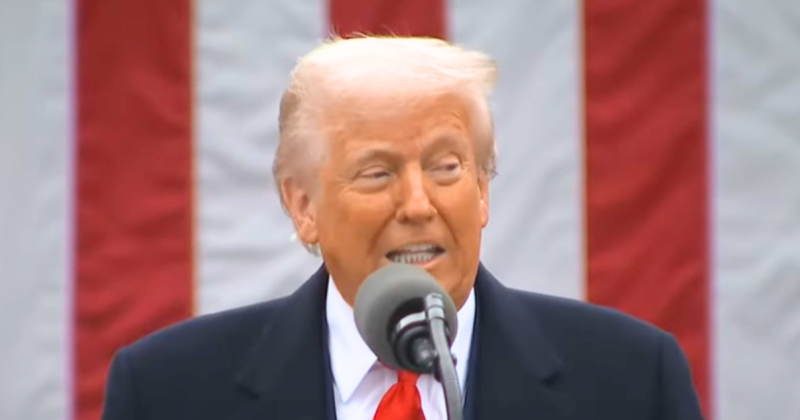
A power struggle in the truest sense has erupted along the US-Canada border, with Ontario’s premier threatening to pull the plug on American electricity as President Donald Trump escalates a punishing new round of tariffs.
The confrontation intensified Monday when Trump unveiled plans to raise tariffs on Canadian automobiles, auto parts and steel to 50 percent, effective January 1, striking directly at an industry that spans both nations.
Ontario Premier Doug Ford wasted no time firing back, branding the American president’s conduct in blunt terms during a radio appearance.
“He’s arrogant. He’s cocky,” Ford said of Trump’s negotiating style.
Electricity emerged as Ford’s most potent bargaining chip, with the premier suggesting Ontario could simply cut the flow of power into the United States if pressure on Canadian manufacturers continued.
“We power 1.5 million homes and businesses,” Ford told the Associated Press. “Everything’s on the table. I’ll do whatever it takes.”
The premier punctuated his warning with a jab aimed squarely at the president.
“He better have a pack of batteries,” Ford added.
Trump answered on Truth Social, characterizing Ford’s threats as bluster and insisting the United States had long propped up its northern neighbor economically.
“The USA will always be far bigger, richer, and stronger than Canada,” Trump wrote, adding that America had been “carrying Canada for decades.”
Electricity is not a minor talking point in this fight. Canada accounted for about 5 percent of New England’s power supply in 2024, a share that has surged as high as 15 percent during peak winter demand.
Ford did not stop at electricity, floating the idea of choking off Ontario’s critical mineral exports as another pressure point against Washington.
“I’ll cut them off,” Ford said. “You won’t get a grain of sand out of Ontario.”
Trump, meanwhile, doubled down on his grievances, accusing Canada of exploiting the trade relationship for years and warning that the country’s status was about to change.
“Canada has been ripping off the United States of America for years,” Trump posted. “Canada will be treated like a state no longer. They feel entitled, and yet, we don’t need Canada, they need us.”
The president also singled out Canadian trade barriers he said had devastated American farmers, framing the tariffs as a defense of domestic agriculture.
Ford rejected that narrative entirely, casting Trump’s actions as a betrayal of a longstanding partnership.
Ford said Trump had “declared war, economic war against his closest friend and ally,” insisting the administration had badly misread Canada’s willingness to retaliate.
In an unusual twist, Ford, a center-right conservative himself, invoked the legacy of former President Ronald Reagan to underscore his criticism.
“He’d be throwing up … if he knew what was going on, spinning around in his grave right now,” Ford said.
Ford continued: “He should maybe take that picture off the wall and move it somewhere else. Because right now, Ronald Reagan would be disgusted with President Trump.”
The latest flashpoint arrives on the heels of collapsed trade talks between Washington and Ottawa, which fell apart last week after a month of negotiations.
Canadian Prime Minister Mark Carney walked away from the table after the US pushed demands he said would have curtailed Canada’s freedom to pursue trade deals with other countries.
Carney labeled the request “unacceptable” and “a question of sovereignty,” vowing his government would strike back.
“Canada will match those tariffs dollar for dollar to protect our workers and businesses,” Carney said Saturday.
Ottawa’s countermeasures are set to take effect September 8, hitting American steel, dairy, agricultural equipment and other exports.
Over the weekend, Washington had already imposed 50 percent tariffs on close to $20 billion in Canadian goods, including agricultural products, dairy, alcohol, clothing and electronics.
The auto sector illustrates just how tangled the two economies have become, with Ontario plants and their American counterparts sharing supply chains so tightly that individual parts can cross the border multiple times before a vehicle is finished.
Ford warned that the new tariffs place Ontario’s auto plants and the jobs tied to them squarely at risk, accusing Trump of dismantling Canadian industry one sector at a time to force production south of the border.
“He wants to bleed out every single sector and bring them down to the US,” Ford said.
Even amid the heated exchanges, Ford left the door open to further talks, signaling he has not given up on diplomacy.
“I never believe in walking away from the table,” Ford said. “Continue negotiating and see where we go.”
