

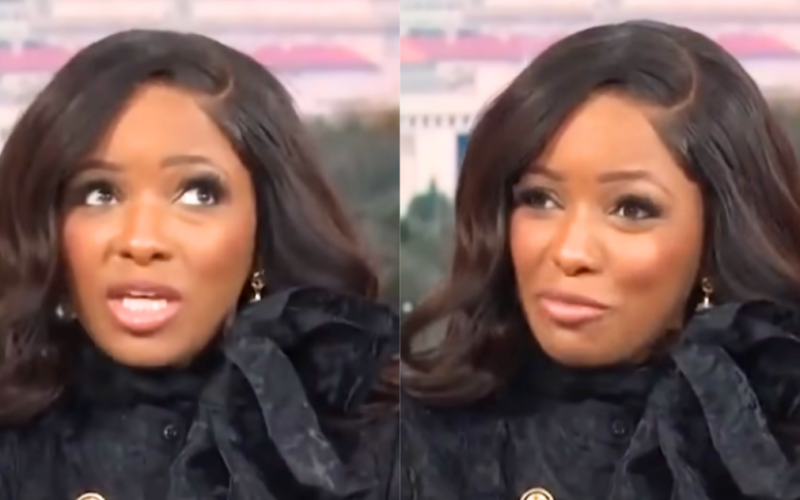
A routine congressional hearing on the Smithsonian Institution veered into unexpected territory this week when a Texas Democrat linked global soccer fandom to racial bias.
The detour came courtesy of Rep. Jasmine Crockett, who used her allotted time to raise questions about why international audiences favored one World Cup finalist over another.
Spain had claimed soccer’s biggest prize just days earlier, edging out Argentina 1-0 in a final that required extra time to settle.
The tournament, watched by audiences across the globe, wrapped up over the weekend before becoming an unlikely talking point on Capitol Hill.
Tuesday’s hearing was originally convened to examine the Smithsonian museums, institutions that have come under fire from congressional Republicans in recent months.
GOP lawmakers have repeatedly criticized what they view as ideologically driven content within various Smithsonian exhibits.
Professor David Blight appeared before the committee as a witness called by Democrats.
What began as testimony related to the Smithsonian’s programming took an abrupt turn when Crockett shifted her questioning toward the recently concluded World Cup.
Rather than focusing on museum policy, Crockett used her time to advance a theory about the motivations of soccer fans worldwide.
She argued that spectators were not merely cheering for Spain but were actively rejecting Argentina, and she tied that rejection to the nation’s past.
Turning to Blight, Crockett framed the tournament as a showcase of diversity before raising her central question.
“I want to go back real quick, though, Dr. Blight, because you talked about the World Cup, the World Cup that that captured the imaginations of the entire world when they saw all of these people of color that was playing for all these teams, and ultimately, if you recall, the last two teams, it was Argentina and Spain, and it seemed like the vast majority of the world was rooting for Argentina, or actually against Argentina, right?” Crockett said.
She pushed further, asking Blight to speculate on the reasoning behind that sentiment. “And why was that? Just give me an explanation if you could guess,” she asked.
Blight’s answer sidestepped any racial explanation entirely, crediting the outcome to competitive merit instead. “Spain’s had the best team. Maybe that’s why they were rooting for them,” Blight said in response.
That answer did not satisfy Crockett, who moved to introduce her own historical framing of the matter. “There’s also a racist history that exists as it relates to Argentina,” Crockett said, attempting to expand on her claim.
Before she could finish, Chairman Tim Burchett intervened. Burchett, who chairs the House Oversight and Government Reform Subcommittee on Delivering on Government Efficiency, cut off Crockett’s line of questioning.
The soccer-related exchange was not the only flashpoint of the day. Crockett went on to level broader criticism at the hearing itself, casting doubt on the motives of her Republican colleagues running the proceedings.
In a striking turn of phrase, Crockett labeled the gathering a “white pride rally disguised as a Congressional hearing,” a characterization that stood in stark contrast to the hearing’s official focus on Smithsonian oversight.
She then suggested that discomfort among certain committee members stemmed from an unwillingness to confront uncomfortable historical realities.
“It might be uncomfortable for some people on this committee to hear about the true history of America, and I hate that for them, but facts are facts,” Crockett said.
The hearing itself was part of a broader, ongoing Republican push to scrutinize Smithsonian content and leadership decisions, with Blight’s testimony serving as one component of that larger review.
Meanwhile, the World Cup final that sparked Crockett’s remarks had already concluded on the field days before her comments, with Spain’s extra-time victory closing out the tournament without controversy from players or organizers.
Crockett’s characterization of both the soccer tournament and the hearing itself quickly became the most discussed portion of a session originally billed as a policy discussion about a federal museum system.
