

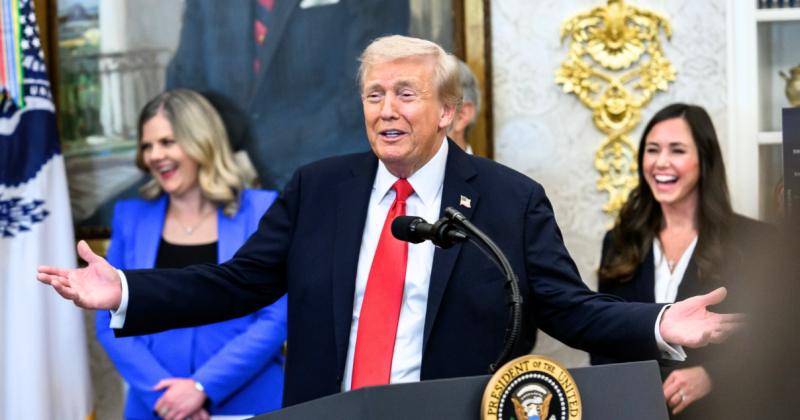
President Donald Trump stood at Arlington National Cemetery on Monday and delivered a Memorial Day address that tied together 250 years of American history with a single, unforgettable sentence.
The cemetery served as the backdrop as Trump addressed the nation on one of the federal government’s most solemn observances, just weeks before the country prepares to mark the 250th anniversary of its founding.
Trump wasted no time connecting the weight of Memorial Day to the celebration rapidly approaching on the calendar. “Less than six weeks from now, our nation will reach a historic milestone, 250 years of majestic American independence,” the president told the crowd gathered at the cemetery.
He did not allow that milestone to stand alone. Trump insisted the nation must first reckon with the cost behind every year of that independence before any celebration begins.
“But it’s only right that first we remember the immense sacrifice that has been brought to us on this momentous anniversary year,” he said.
The president then laid out the relationship between honoring the dead and celebrating the nation’s birth in terms that left little room for misinterpretation.
“That’s what it is. It’s a momentous year. Before we hail the Founding, we honor the fallen. Before we celebrate the triumph, we pay the tribute. Before we crown the victory, we count the cost,” Trump said.
What followed became the defining statement of the entire address. Nine words formed the sentence that encapsulated the argument Trump had been building.
“Today, we are reminded that there could be no Fourth of July without America’s armed forces and there could be no Independence Day without Memorial Day,” the president declared.
Trump’s speech did not begin American history at the Civil War, where Memorial Day itself finds its origins.
The address pushed further back, to the spring of 1775 and the Massachusetts towns of Lexington and Concord.
It was there, in April of that year, that colonial militiamen — ordinary civilians — raised their weapons against the British Empire, then the most formidable military force on the planet.
Those confrontations at Lexington and Concord occurred more than a year before any formal declaration of nationhood.
The Second Continental Congress would not issue the Declaration of Independence from Philadelphia until the summer of 1776.
Trump’s address drew a straight line from those first armed Americans who fell on Massachusetts soil, through the Declaration, and into the present day — framing every generation of military sacrifice as part of a single, unbroken chain.
Memorial Day itself grew out of the Civil War era, when citizens on both sides of a divided nation began holding ceremonies at the graves of fallen soldiers, a tradition that eventually became a national institution.
The remarks generated significant response across social media platforms Monday. Commentator Nick Sortor published the president’s core statement on X, amplifying the line connecting Independence Day to Memorial Day to a wide online audience.
The address prompted comparisons to one of the most remembered presidential speeches of the modern era. Following the Space Shuttle Challenger disaster in January 1986, President Ronald Reagan addressed a grieving nation live on television.
Reagan closed that speech with words his then-speechwriter Peggy Noonan had lifted from a wartime poem. “We will never forget them, nor the last time we saw them, this morning, as they prepared for their journey and waved goodbye and ‘slipped the surly bonds of earth’ to ‘touch the face of God,’” Reagan said.
The author of those lines was John Gillespie Magee Jr., a pilot who was killed during a training exercise in 1941, years before the war he served in reached its conclusion.
President Abraham Lincoln once described the American republic as a nation “dedicated to the proposition that all men are created equal” — words that presidents across generations have returned to when attempting to explain what the country’s founding actually meant.
Trump’s Monday address placed the men and women buried at Arlington within that same founding tradition, arguing that the soldiers remembered on Memorial Day are not separate from the American story but are, in fact, the reason it has continued for 250 years.
