

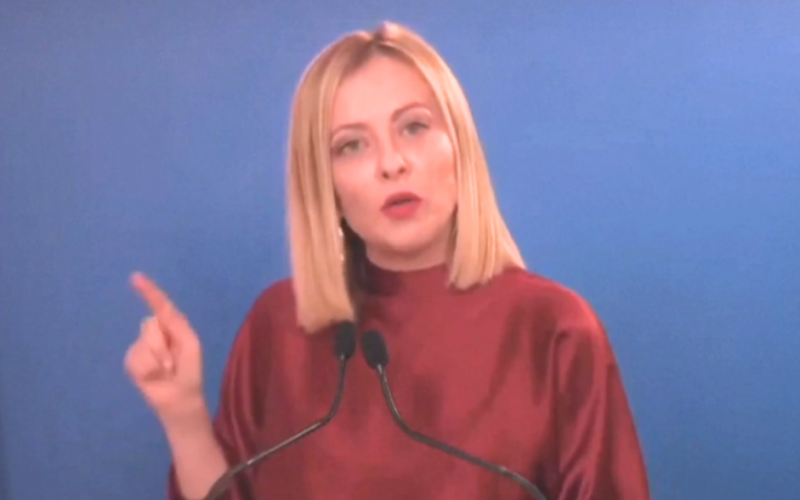
A sitting head of government did something Tuesday that no political playbook could have anticipated — she published the fabricated, AI-generated image of herself that her opponents had been quietly circulating, and she did it on her own terms.
Italian Prime Minister Giorgia Meloni brought the smear campaign into the open by posting one of the manipulated photos directly to her social media accounts, stripping her opponents of the secrecy on which that kind of attack depends.
The image depicted Meloni in scanty underclothes and had reportedly been moving through online circles for several days before she seized control of the narrative.
She did not simply express outrage. She let the absurdity of the situation speak, noting in her post on X that whoever had created the fabricated image had, at the very least, done her a certain favor.
“I must admit that whomever created them — at least in the case attached here — actually improved my appearance quite a bit,” she wrote, according to a translation reviewed by the Daily Caller.
Meloni also included in her post a screenshot from a social media user who had accepted the image as genuine. That user had declared her appearance in the fabricated photo “shameful and unworthy of the institutional role she holds,” according to a translation from Euronews.
The prime minister identified the source of the images as political opposition. “Several fake photos of me — generated using artificial intelligence and passed off as real by some overzealous opponent — are currently circulating,” she wrote.
What followed in her post was less about herself and more about everyone else. Meloni warned that the threat posed by artificial intelligence image manipulation does not stop at the doors of the powerful.
“Deepfakes are a dangerous tool, as they have the power to deceive, manipulate and target anyone. I am able to defend myself. Many others are not,” she wrote.
Followers who encountered her post on Facebook responded by calling on Meloni to involve law enforcement, the Associated Press reported.
Whether her office intends to pursue that course of action in connection with the latest round of images had not been confirmed at the time of publication.
Meloni is no stranger to this particular brand of political warfare. In February, a separate incident arose involving a Roman church fresco that reportedly bore a resemblance to the prime minister — something she dismissed publicly with a laughing emoji.
A far more serious episode preceded that one. In 2024, Meloni initiated a civil lawsuit exceeding $117,000 against two men she accused of producing deepfake videos of her that were ultimately distributed on an American pornographic website, according to Euronews.
Around the same period, a website hosting deepfake pornographic images of prominent Italian women — Meloni among them — was shut down, and prosecutors in Rome opened a formal investigation into the matter.
Meloni’s government has pursued the issue at the legislative level as well, successfully pushing through a law that classifies deepfakes inflicting “unjust harm” as a criminal act.
That legislation runs parallel to the European Union’s broader AI Act, which establishes continent-wide penalties and safeguards against the misuse of the technology.
In closing her post, Meloni directed a message to ordinary internet users, encouraging them to verify content before accepting it and to pause before amplifying anything they encounter online.
The Daily Caller has reached out to Prime Minister Meloni’s office for comment.
