

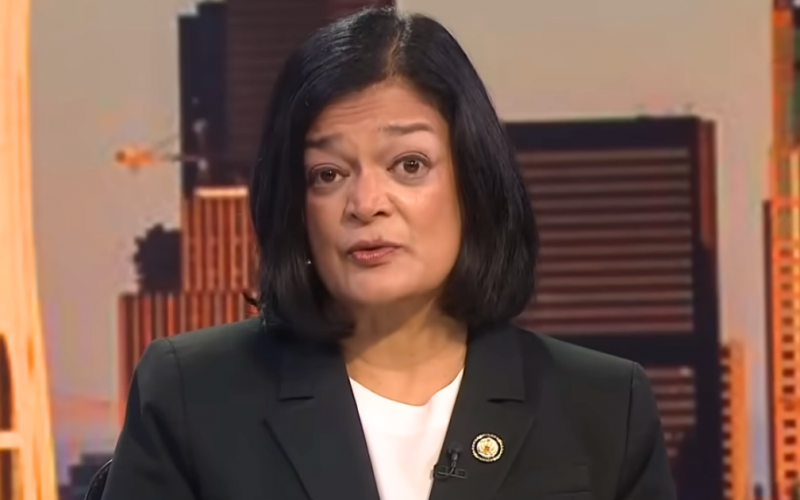
President Donald Trump’s escalating sanctions campaign against Cuba is drawing renewed political backlash after Rep. Pramila Jayapal (D-WA) acknowledged speaking with diplomats from multiple Latin American countries about efforts to address worsening fuel shortages on the communist-run island.
Jayapal made the comments during a recent Cuba-focused briefing while discussing new executive actions signed by Trump targeting foreign governments, companies, and financial institutions that continue doing business with Havana.
The Washington Democrat argued the administration’s policies are intensifying an already severe humanitarian and infrastructure crisis as Cuba struggles with ongoing blackouts, fuel shortages, and economic instability.
During the event, Jayapal claimed Cuba’s energy problems sharply worsened after Venezuelan oil shipments to the island declined earlier this year.
She said only a limited amount of Russian oil had recently arrived and warned that fuel supplies remained dangerously low.
Jayapal also revealed she had been speaking with ambassadors from Mexico and other Latin American nations about potential ways to help Cuba secure additional energy resources.
“In January, Trump issued an executive order threatening tariffs on any country supplying fuel to Cuba,” Jayapal said during the briefing.
She argued the administration’s latest sanctions have made it increasingly difficult for foreign governments and businesses to assist the island without risking economic penalties from the United States.
Jayapal’s comments came several weeks after she and Rep. Jonathan Jackson (D-IL) traveled to Cuba for meetings with Cuban President Miguel Díaz-Canel, Foreign Minister Bruno Rodríguez Parrilla, and members of the Cuban Parliament, according to The Gateway Pundit.
The delegation’s visit centered largely on Cuba’s deepening fuel shortages and the economic fallout tied to longstanding U.S. sanctions.
Jayapal’s comments immediately ignited backlash from Republicans on Capitol Hill.
Florida Sen. Rick Scott accused Democrats of openly coordinating with foreign governments to weaken U.S. sanctions policy.
In a post on X, Scott wrote that members of the Democratic Party were “OPENLY admitting to aiding a communist adversary in coordination with foreign countries to VIOLATE American sanctions.”
He argued the restrictions were necessary to protect American national security interests and pressure Cuba’s communist leadership.
Scott also defended Trump’s broader strategy toward Havana, saying the administration was attempting to hold the Cuban government accountable for supporting hostile actors and contributing to instability throughout the region.
According to Breitbart, the Florida senator has long supported aggressive sanctions against Cuba and has repeatedly criticized Democrats who advocate easing restrictions on the island nation.
Jayapal, meanwhile, sharply criticized the administration’s latest sanctions package, comparing the economic restrictions to warfare.
She described the measures as “an economic bombing of the infrastructure of Cuba” and argued the sanctions were crippling the island’s ability to maintain basic services by restricting fuel access and limiting financial transactions with foreign institutions.
She also claimed the measures violate international norms by effectively collapsing critical infrastructure through economic pressure.
Her remarks additionally sparked renewed online discussion about the Logan Act, a centuries-old federal law prohibiting unauthorized negotiations with foreign governments involving disputes with the United States.
Although prosecutions under the law have historically been extremely rare, critics argued Jayapal’s comments warranted scrutiny because of her admitted discussions with foreign diplomats regarding Cuba’s oil supply.
Trump’s January executive order significantly expanded economic pressure on Havana by authorizing tariffs and penalties against foreign entities that continue supplying fuel or financial support to Cuba’s government.
The administration said the policy was part of a broader effort to counter the Cuban regime’s regional influence and increase pressure on the Díaz-Canel government.
Trump also declared at the time that “THERE WILL BE NO MORE OIL OR MONEY GOING TO CUBA.”
WATCH:
