

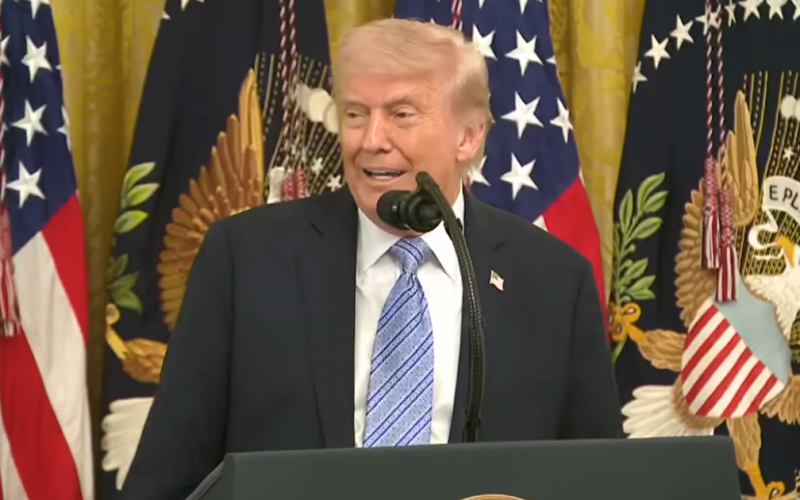
President Donald Trump’s influence over Republican politics in Indiana became a defining force in a series of state Senate primaries that exposed widening divisions within the party over loyalty, strategy, and control of legislative priorities.
The elections were shaped by an earlier conflict over a proposed mid-decade redistricting plan that would have redrawn Indiana’s congressional map in a way that favored Republicans.
Trump had publicly supported the proposal as part of a broader effort to strengthen GOP control in Congress.
However, a group of Republican state senators joined Democrats in blocking the measure, a decision that ultimately set off a wave of primary challenges targeting those lawmakers.
That vote quickly became the central issue driving the primary contests.
What began as a procedural dispute inside the state legislature evolved into a wider political test of alignment with Trump’s national agenda.
In response to the blocked redistricting effort, Trump and allied political groups endorsed challengers in several Republican primaries, transforming traditionally local races into heavily nationalized contests with significant outside attention and funding.
Financial support played a major role in amplifying the scope of the races, according to USA Today.
Trump-aligned organizations and affiliated political networks invested more than $10 million in advertising and campaign efforts aimed at defeating incumbents who had opposed the redistricting plan.
State Republican leadership attempted to defend sitting senators, but the scale of outside spending helped elevate the challengers and shift the tone of several contests into high-intensity political battles.
When votes were counted, Trump-endorsed candidates secured victories in most of the targeted races, with multiple incumbents losing their seats and others narrowly surviving.
The results varied by district but overall showed strong performance by challengers aligned with Trump’s endorsements, signaling his continued influence over Republican primary voters in the state.
Despite the broad success of Trump-backed candidates, the results were not uniform across all races.
A small number of incumbents held onto their seats, while a few contests remained extremely close, according to the IndyStar.
That mix of outcomes underscored that while Trump’s endorsement remains a powerful force within Republican primaries, it does not guarantee consistent results across all districts or voter demographics.
The outcome quickly sparked competing interpretations inside the Republican Party.
Supporters of the challengers described the results as a rejection of establishment resistance and a sign that voters were aligning more closely with Trump’s political direction.
Some Trump allies framed the elections as evidence of a reshaped state party that is increasingly aligned with national priorities rather than internal legislative caution, according to The Blaze.
By contrast, some defeated incumbents and their supporters pushed back against that framing, arguing that the races were heavily influenced by outside spending and national political pressure rather than local policy disagreements.
They contended that the focus on redistricting had turned what were traditionally state-focused elections into referendums on national political loyalty.
Beyond the immediate election results, attention has shifted to the broader implications for Indiana’s legislative direction.
If the newly elected lawmakers prevail in the general election, they could alter the balance of power within the Republican caucus in the state Senate.
That shift could make future efforts at redistricting more likely to align with Trump-backed priorities, particularly regarding congressional map drawing and party advantage strategies.
The races also highlight a broader trend in American politics: the increasing influence of national figures and organizations in state-level elections.
Once largely shaped by local issues and regional party structures, contests like these are now frequently influenced by national endorsements, outside spending networks, and broader ideological battles within political parties.
As the dust settles, Indiana’s primaries are being viewed as another example of how internal Republican divisions continue to play out at the state level, with long-term implications not only for legislative control in Indiana but also for how state parties navigate alignment with national political figures in future election cycles.
WATCH:
