

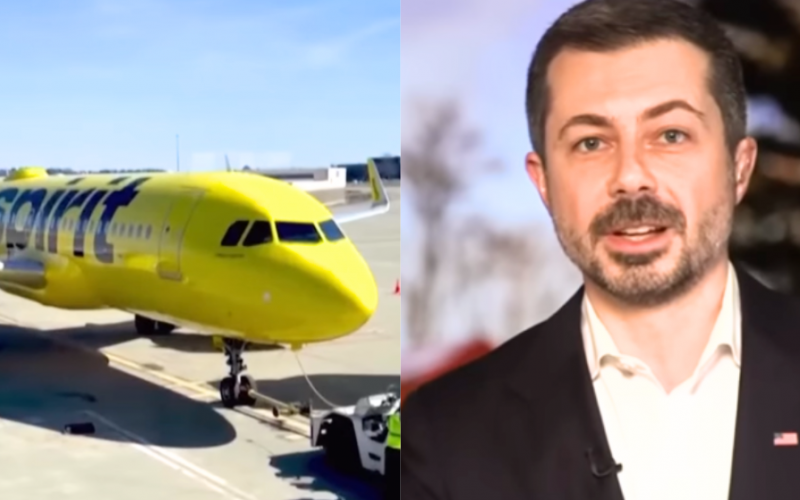
When Pete Buttigieg stepped in front of CNN cameras in 2023, he was not shy about what his agency had just done. The then-Transportation Secretary made clear that Washington had planted its flag in the middle of a corporate deal — and he was proud of it.
The deal in question was JetBlue’s proposed $3.8 billion purchase of Spirit Airlines. The Biden administration moved swiftly to kill it reported by Politico.
Three years later, Spirit Airlines no longer exists. On May 2, 2026, the carrier announced it was shutting down permanently. Every plane was grounded. Every employee was let go. Every ticket became worthless overnight.
Seventeen thousand workers woke up that Saturday without jobs.
Spirit made the announcement through its restructuring website, offering a brief and final statement to the traveling public.
“It is with great disappointment that on May 2, 2026, Spirit Airlines started an orderly wind-down of our operations, effective immediately,” the company wrote.
The message to passengers was blunt. “All flights have been cancelled, and customer service is no longer available,” Spirit’s statement read.
The airline signed off with a look back at its own history. “We are proud of the impact of our ultra-low-cost model on the industry over the last 33 years and had hoped to serve our Guests for many years to come,” it said.
Thirty-three years of flights, routes, and rock-bottom fares — ended in a single weekend.
The Biden administration’s effort to stop the JetBlue merger had been anything but quiet. In March 2023, the Departments of Justice and Transportation coordinated a joint legal and regulatory assault on the deal.
The DOJ sued in federal court, charging that absorbing Spirit into JetBlue would shrink consumer options and push ticket prices higher.
The attorneys general of Massachusetts, New York, and the District of Columbia signed on to the federal lawsuit. The combined carrier, had it survived legal scrutiny, would have ranked as the fifth-largest airline in the country.
JetBlue and Spirit had pushed back. Both companies maintained that despite a reduction in available seats, fares for travelers would stay competitive. The courts sided with the government. The merger was blocked.
Buttigieg, speaking during a CNN interview at the time, was direct about the departure his agency was making from standard practice.
“Our department, the Department of Transportation, has generally not gotten involved in these merger cases, but that’s changing today,” he said.
He pressed the point further. “It is so important to make sure that passengers have choices, that they have access to low fares, that they have access to competition. And, yet we’ve seen less and less and less of that competition over the years,” Buttigieg continued.
He described the move as deliberate and expansive.
“We are taking a step, that again, is unusual in terms of recent years, but we think is the right thing to do — supporting the DOJ’s lawsuit, and independently using our own authorities, which are a little bit different from the DOJ — starting our own investigation and taking other actions,” he said.
Washington got what it wanted. The merger collapsed. Spirit limped forward alone.
Without the financial backing of an acquisition, Spirit never found a stable footing. The carrier that once advertised the cheapest seats in American aviation filed for bankruptcy and eventually stopped flying altogether.
The fares Buttigieg said he was protecting are now gone. The competition he said he was preserving has been removed from the market entirely.
The passengers he invoked are now left with fewer options than they had before the federal government stepped in.
