

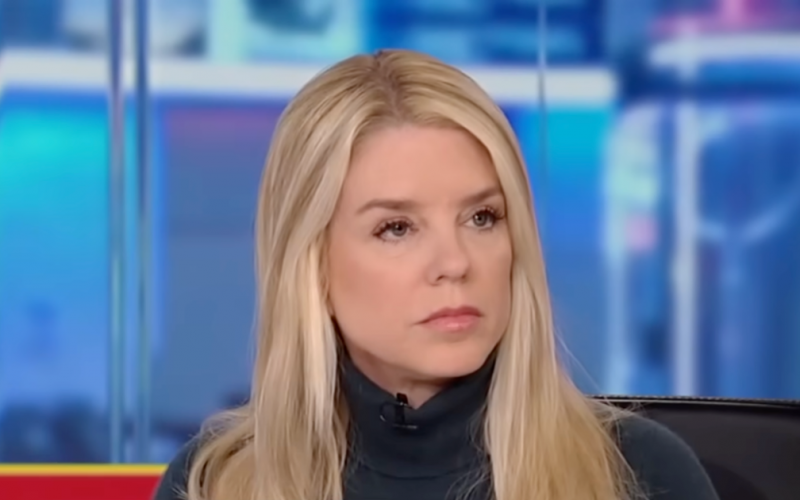
Attorney General Pam Bondi has reportedly been moved to a heavily guarded military base near Washington, D.C., after federal authorities flagged threats against her safety.
The New York Times reported that Bondi was relocated from her Washington apartment within the past month after law enforcement warned of potential threats against her.
Officials reportedly raised concerns about threats tied to drug cartels as well as backlash surrounding the Justice Department’s handling of documents connected to convicted sex offender Jeffrey Epstein.
The report did not reveal which military installation Bondi is now staying on, and authorities have not disclosed specific details about the threats for security reasons.
According to officials familiar with the situation, security concerns increased after the Trump administration captured Venezuelan leader Nicolás Maduro earlier this year.
A senior official with knowledge of the situation said the development triggered additional threats directed at Bondi.
Bondi has also faced criticism over how the Justice Department handled the release of Epstein-related materials, an issue that continues to fuel controversy in Washington.
The case involving Epstein has remained politically explosive, and the release of related files has drawn scrutiny from critics who have demanded more transparency.
Officials have not publicly confirmed the specific nature of the threats against Bondi, but the decision to move her to a military installation suggests security officials considered the situation serious.
Bondi is not the only senior Trump administration official reportedly staying on a military installation for security reasons.
Other officials said to be living on military bases include senior White House adviser Stephen Miller, Secretary of State Marco Rubio, Defense Secretary Pete Hegseth, and former Homeland Security Secretary Kristi Noem.
Army Secretary Daniel Driscoll has also reportedly moved into military housing.
Navy Secretary John Phelan is also said to be living on a military installation after his Washington home was damaged by a fire last year, per Trending Politics.
The report noted that several of these residences are located on historic military properties in the Washington area.
It remains unclear how much the officials are paying to stay in the government housing.
At least one official previously said they were paying “fair-market rent” for accommodations located on a military installation.
Security arrangements like this are sometimes used when federal officials face credible threats.
Military bases provide significantly stronger security infrastructure compared to private residences or standard government housing.
Relocating officials to those installations allows federal law enforcement and military personnel to coordinate protection more effectively.
In Bondi’s case, the combination of cartel threats and political backlash appears to have prompted authorities to take additional precautions.
Officials have not commented publicly on how long Bondi will remain on the military base.
For now, her exact location remains confidential as federal authorities continue monitoring the situation and assessing potential risks.
The relocation highlights the growing security concerns surrounding top administration officials as political tensions and international conflicts continue to escalate.
While details about the threats remain limited, the decision to move the nation’s top law enforcement official onto a secured military installation underscores the seriousness of the warnings federal authorities received.
