

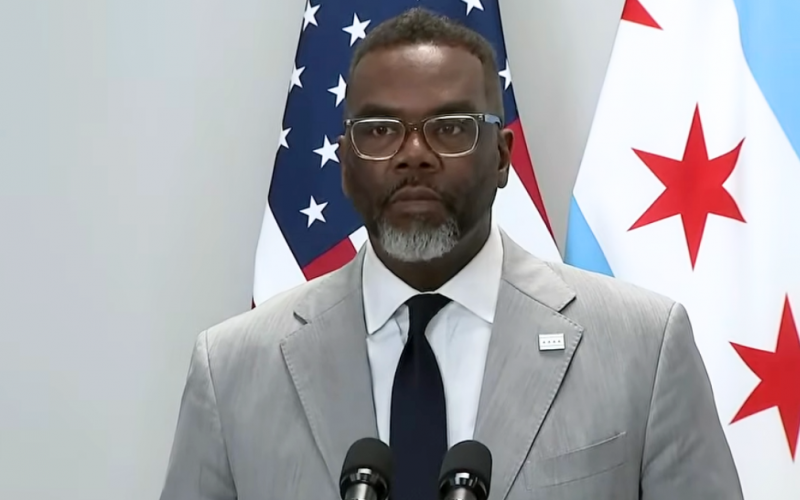
Backlash erupted across Chicago and online after Mayor Brandon Johnson (D) unveiled a city snowplow named “Abolish ICE,” sparking criticism over the timing in the wake of Sheridan Gorman’s murder.
The unveiling was part of Chicago’s annual “You Name a Snowplow” contest, which received roughly 13,000 submissions.
About 70 percent of entries featured “Abolish ICE,” reflecting a coordinated push behind the slogan.
City officials framed the winning name as reflecting Chicago’s values, while critics argued the timing overshadowed the civic initiative, according to the Chicago Sun-Times.
“This name derives from our city’s legacy of standing up for justice, dignity and the rights of all people no matter where they come from,” Johnson said. “I want to take this moment to reiterate that Chicago does not want ICE on our streets, in our airports nor in our city. Chicago believes in abolishing ICE.”
The event came less than a week after 18-year-old Loyola University Chicago freshman Sheridan Gorman was shot and killed near campus.
Authorities charged Jose G. Medina, an illegal alien from Venezuela with prior federal detentions, in connection with the killing.
The proximity of the events drew swift criticism from residents and observers.
Tensions flared during the unveiling when a heckler shouted, “You’re making a joke out of Sheridan Gorman! Shame on you!”
Johnson responded with condolences, saying, “My condolences to the family of Sheridan. This is a terrible tragedy,” while defending his policies and affirming his commitment to city governance.
He added that Gorman’s killing would not “deter us from our work.”
Online criticism also intensified.
Florida’s Voice Eric Daugherty wrote, “Vile SCUM,” adding, “Is he freaking serious? RESIGN, TRAITOR!”
Conservative influencer Paul A. Szypula commented, “Unbelievable. Johnson found a way to make this even worse,” while conservative commentator Benny Johnson stated, “Johnson needs to resign—this display is unforgivable.”
The snowplow controversy has reignited focus on Chicago’s sanctuary city policies, which limit cooperation with federal immigration enforcement.
Johnson’s past actions have added fuel to the debate.
During his tenure, he faced criticism for sanctuary city measures that restricted collaboration with federal authorities—even in cases involving serious crimes.
Policies allowing illegal aliens access to municipal benefits also drew backlash from law enforcement and some community groups.
Supporters argue the policies protect immigrant communities and encourage trust in local law enforcement, while critics say they create enforcement gaps.
Recent federal immigration operations in the city have heightened the debate.
Federal and local tensions have grown in recent months.
Immigration agents were recently deployed to assist at O’Hare International Airport during staffing shortages—a move Johnson criticized as an overreach.
The presence of federal agents at key transit hubs has highlighted the divide between city and federal priorities.
Community responses reflect deep divisions.
Vigils have been held for Gorman alongside calls for stricter immigration enforcement, while advocacy groups continue pushing for protections for illegal residents.
The tragedy has intensified an already contentious dialogue about safety and policy.
What began as a lighthearted civic contest has now become a flashpoint in Chicago’s political debate.
The snowplow, intended as a symbol of engagement, now underscores the city’s ongoing struggle to balance public safety, immigrant protections, and civic values.
WATCH:
