

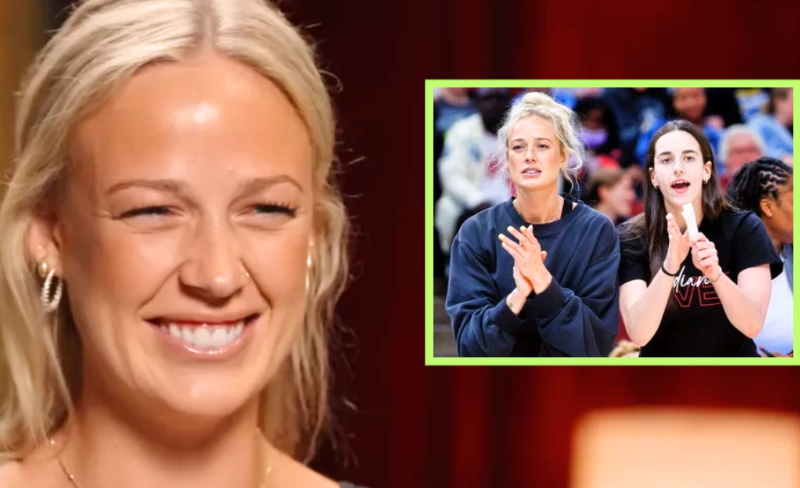
A firestorm of assumptions has followed Sophie Cunningham for years. Now the Indiana Fever guard is finally addressing it head-on.
Speculation has swirled around the basketball star’s true feelings on transgender athletes competing in women’s sports. Cunningham decided it was time to correct the record.
Frustration crept into her voice as she recounted the criticism lobbed at her. “I got a lot of negative feedback about me hating trans. And I’m like, ‘I never once said that,’” Cunningham told ESPN.
Rather than hostility, Cunningham insists her motivation comes from a different place entirely. She frames her advocacy around protection, not prejudice.
“I think that I am here to extend love. But I also think with that love is truth, being honest. And I want to protect young girls in a locker room, or young girls in sport who shouldn’t have to go against biological men,” she added.
Politically, Cunningham refuses to be boxed into a single category. She described herself as someone who draws from multiple perspectives rather than aligning strictly with one side.
“I’m very much in the middle. I agree with things on both sides, disagree with things on both sides. And that’s all I’ve ever said about my political beliefs. But people love to assume,” she said.
That refusal to be labeled hasn’t stopped others from doing exactly that. Critics within the league’s fan base and commentary circles have slapped her with the nickname “MAGA Barbie.”
Cunningham has leaned on her own experience as a professional athlete to justify why her voice belongs in this conversation.
She argues her time competing at the highest level gives her standing to speak on fairness and safety in the sport.
This is far from the first time Cunningham has found herself at the center of this exact storm. Years earlier, a single social media repost thrust her into the national spotlight.
Back in March 2022, Cunningham retweeted a CBS Sports post written by Josh Pate. The subject was Lia Thomas, a biological male competing in collegiate women’s swimming who had shattered numerous records in the sport.
The post Cunningham shared carried a blunt message: “Female collegiate athletes deserve so much better than this.”
Backlash arrived almost immediately. Left-leaning groups and individual critics condemned her online, and the pressure eventually became too much to ignore.
Cunningham responded with a formal apology, one that attempted to clarify her values without abandoning her original point.
“To my teammates, friends, family, supporters and fans, you know that I stand with all people, especially my fellow athletes. I do not judge, but support all races, religions, sexual preferences and gender equity. We all have a place in this world to compete and I hope we are able to grant everyone that opportunity fairly,” she wrote.
That apology came more than three years ago, yet questions about her true stance have lingered ever since.
Cunningham’s on-court résumé tells its own story. She spent six seasons suiting up for the Phoenix Mercury before her move to Indiana.
Now a member of the Fever, she shares the roster with Caitlin Clark, the transcendent talent widely credited with fueling the league’s explosion in popularity.
Statistically, Cunningham has carved out a niche as one of the WNBA’s more dangerous shooters from three-point range, ranking among the league’s best in recent seasons.
Her game isn’t limited to offense, either. Coaches and teammates alike have praised her defensive contributions, another area where she has become a reliable presence.
The broader conversation Cunningham has waded into shows no signs of fading. Transgender participation in women’s and girls’ athletics remains a flashpoint across professional, collegiate, and youth sports nationwide.
For her part, Cunningham insists she isn’t picking a side in a culture war. She frames her position as rooted in athlete safety and competitive fairness, not opposition to any group of people.
As the WNBA season continues, Cunningham remains a fixture both on the court and in the middle of a debate that refuses to go away.
