

Trust sits at the center of every teleprompter operator’s job inside the West Wing. For nearly a decade, that trust belonged to Gabriel Perez, the man who loaded President Trump’s speeches onto the screen before the nation ever heard them spoken aloud.
That trust has now cost him his paycheck.
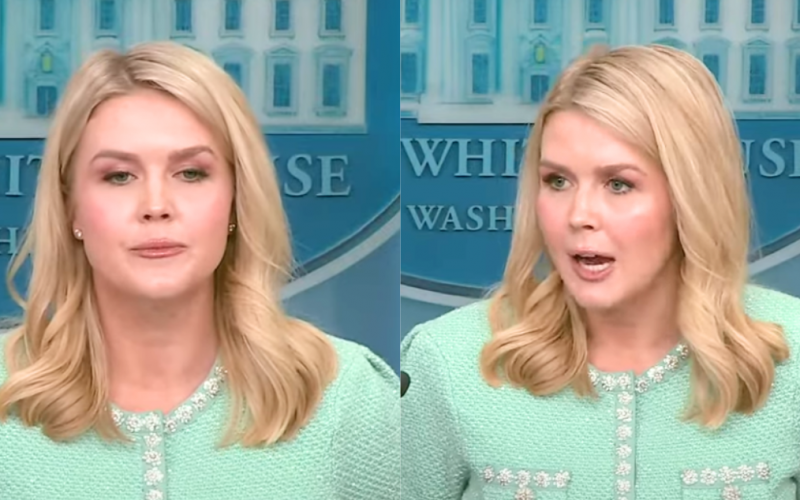
White House press secretary Karoline Leavitt announced Thursday that Perez would sit out the president’s primetime address to the nation that evening, confirming he had been placed on administrative leave without pay.
Leavitt briefly fumbled the announcement in real time, first calling the leave “paid” before catching her own error in front of reporters.
“I’m sorry, without pay. The administrative leave is unpaid. To be very clear, that was a decision by the president,” she said, correcting herself.
Behind the punishment lies a scheme built on early access.
Perez, serving since 2016 as the operator who fed presidential remarks into the teleprompter, allegedly used his preview of Trump’s language to wager on prediction platform Kalshi.
The site lets users bet on whether a public figure will utter specific words, phrases, or subjects during a live appearance — a niche corner of the gambling world known as a “mention market.”
Federal records and reporting show Perez placed such bets across more than a dozen Trump addresses.
The list includes February’s State of the Union, a January appearance before the World Economic Forum in Davos, Switzerland, and a December primetime speech, according to ABC News.
The payout was substantial. Perez pulled in upwards of $90,000 in profit from his trades, though that money now sits frozen pending review, CNN reported.
Regulators at the Commodity Futures Trading Commission are now examining the trades directly with Perez’s involvement, according to a source familiar with the matter.
“Perez is fully cooperating with the CFTC on the matter,” the source told The Post.
It wasn’t outside reporters who first caught the pattern — it was Kalshi’s own internal monitoring system. The company’s enforcement team identified the unusual activity and alerted federal authorities before the story broke publicly.
Robert DeNault, Kalshi’s head of enforcement and legal counsel, confirmed the company’s role in a social media statement.
“The Kalshi surveillance team promptly flagged, investigated and referred these trades to the CFTC,” DeNault wrote, adding that the platform has cooperated fully with investigators.
“We have been assisting regulators on this matter and provided all evidence that we collected, as we do with any referral,” he said.
The CFTC has not publicly detailed its findings. A spokesperson for the agency declined to comment when contacted.
Perez’s financial footprint at the White House extended well beyond his teleprompter duties. Government payroll records list his title as deputy assistant to the president, a post that paid $175,000 annually.
Leavitt relayed the president’s own reaction to learning about his longtime aide’s conduct, describing it in blunt terms.
“He believes it is deeply unfortunate and, frankly, a disgrace,” she told reporters.
She went further, laying out the ethical framework every White House employee is bound by upon joining the administration.
“There are very strict ethical guidelines here at the White House that explicitly state not to do this, and the White House Counsel’s office makes that clear to all of us who sign up to work in government on behalf of the president,” Leavitt said.
Responsibility, she made clear, rests with Perez alone. “This individual unfortunately violated the plan, and therefore he’s paying the consequences,” she said.
Every incoming staffer signs a formal ethics pledge as part of onboarding, Leavitt confirmed, though she said she couldn’t say whether Kalshi’s platform was accessible or restricted on White House computer networks.
Perez’s case is not the administration’s first brush with prediction-market misconduct this year. In April, prosecutors charged U.S. Army Master Sgt. Gannon Ken Van Dyke with using classified military intelligence for personal profit.
Van Dyke allegedly drew on nonpublic details about a covert raid targeting Venezuela to collect roughly $409,000 in winnings on a separate platform, Polymarket.
Court records show he placed 13 individual bets worth a combined $33,000 between late December 2025 and early January 2026, wagering on the operation that ended in the capture of Venezuelan leader Nicolás Maduro.
Van Dyke has entered a not-guilty plea and awaits trial. His prosecution marked the first time the Justice Department brought insider-trading charges tied to a prediction market, with the CFTC filing parallel civil charges.
That earlier case prompted the White House to circulate a staff-wide memo in March, explicitly warning employees against using nonpublic government information to place prediction-market bets.
Prediction markets have exploded in popularity nationwide, drawing bettors into wagers ranging from presidential necktie colors to championship sports outcomes. As of now, no criminal charges have been filed against Perez.
