

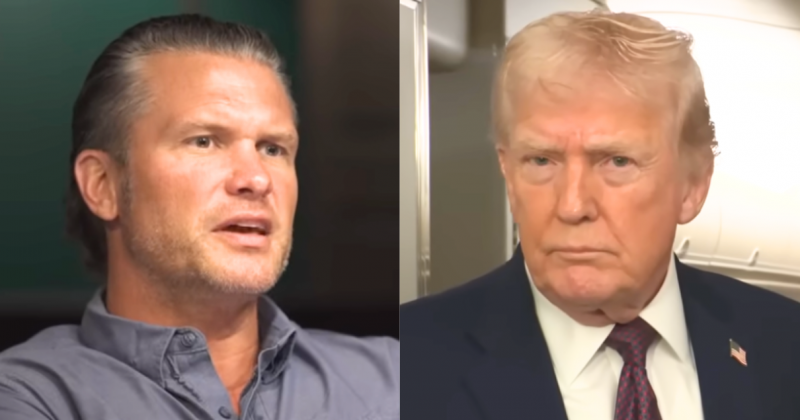
Defense Secretary Pete Hegseth faces mounting scrutiny after ordering a Sept. 2 strike in the Caribbean that killed 11 people aboard a suspected drug trafficking vessel, with military experts now questioning whether the operation violated international law.
The attack marked the first deadly U.S. strike on an alleged narcoterrorist boat in Caribbean waters.
According to reports, the military deployed an aircraft disguised as a civilian plane to carry out the mission, raising concerns about potential war crimes.
Retired Maj. Gen. Steven J. Lepper, who previously served as deputy judge advocate general for the United States Air Force, told The New York Times the tactics employed may constitute “perfidy,” an offense prohibited under international law.
The concern centers on the military’s decision to use an aircraft that did not display visible identification as a combat vessel.
“Shielding your identity is an element of perfidy. If the aircraft flying above is not identifiable as a combatant aircraft, it should not be engaged in combatant activity,” Lepper stated.
The Pentagon reportedly concealed the aircraft’s military purpose by not visibly carrying munitions under the craft’s wings.
Following this initial strike, military operations have shifted to using MQ-9 Reaper drones and conventional military aircraft for similar missions.
Hegseth has maintained that every individual aboard the targeted vessel appeared on a military target list.
The Defense Secretary authorized the strike as part of broader counternarcotics operations in the region.
Pentagon spokesperson Kingsley Wilson defended the operation’s legality.
“The U.S. military utilizes a wide array of standard and nonstandard aircraft depending on mission requirements,” Wilson said in a statement outlined by the Times.
He added that all aircraft undergo rigorous procurement processes to ensure compliance with domestic law, department policies and international standards, including the law of armed conflict.
The Trump administration has justified these attacks by asserting that the United States is engaged in armed conflict with narcoterrorists, per media reports.
This legal framework provides the basis for military action against drug trafficking organizations operating in international waters.
Lee Zeldin, current EPA Administrator and former U.S. Army instructor on the law of armed conflict, dismissed the war crime allegations. Zeldin explained that military restrictions apply to specific protected symbols.
“What the military can’t do is add certain symbols to pretend the plane is Red Cross, UN, or something otherwise protected,” he stated.
Zeldin further clarified that painting commercial airline logos on military aircraft would constitute illegal deception. However, he argued that an unmarked military plane does not automatically qualify as a civilian aircraft under international law.
Sources indicated the aircraft’s transponder transmitted a military tail number during the operation.
Despite this detail, retired Navy Captain Todd Huntley suggested this measure would not resolve potential perfidy concerns and noted the aircraft type was not designed for offensive operations.
Retired lieutenant colonel JAG officer Geoffrey Cron emphasized the central issue.
“The critical question is whether there is a credible alternative reason for using an unmarked aircraft to conduct the attack other than exploiting apparent civilian status to gain some tactical advantage,” Cron explained.
The Sept. 2 incident initiated a campaign of at least 35 boat attacks that have resulted in 123 deaths.
Legal experts have stated that targeting survivors from the initial strike could constitute a war crime, prompting bipartisan calls for accountability from lawmakers.
Admiral Frank “Mitch” Bradley testified before Congress in early December that all individuals aboard the targeted vessels were identified as narco-terrorists eligible for lethal targeting.
Bradley confirmed that all 11 people killed in the September 2 strike had been positively identified before the attack, reported NBC News.
During his Capitol Hill testimony, Bradley clarified that survivors from the initial strike prompted third and fourth strikes to sink the vessel completely.
He maintained that he acted legally throughout the operation and followed orders from Hegseth as instructed.
