

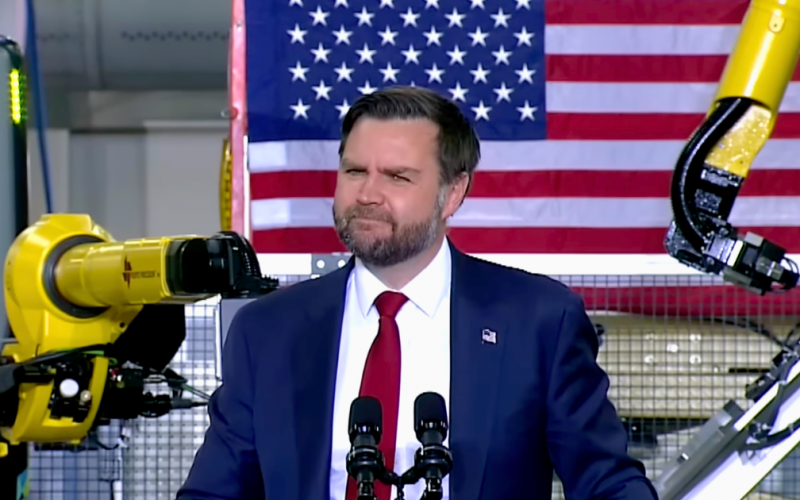
Vice President J.D. Vance refused to reveal what advice he gave President Donald Trump about the Iran strikes, telling reporters he would not discuss private conversations with the president.
Vance made the remark when a reporter asked what he had told Trump before the United States launched military action against Iran.
“I hate to disappoint you but I will not show up here in front of God and everyone else and tell you what I said in the classified room,” Vance said.
He added that discussing those conversations publicly could have serious consequences.
“Partially because I don’t want to go to prison,” the vice president said, drawing loud applause from the audience.
Vance also argued that presidents must be able to speak openly with their advisers without those discussions being leaked to the media.
“I think it’s important for the president of the United States to talk to his advisors without those advisers running their mouth to the American media,” he said.
The comment comes as the war with Iran enters its third week following the launch of Operation Epic Fury.
While Trump has repeatedly referred to the conflict as a war, Vance has largely avoided using that language publicly.
The vice president has long promoted an anti-war message, shaped by his experience serving as a Marine during the Iraq War.
Before entering the White House, Vance frequently warned against prolonged foreign conflicts.
Trump has acknowledged that he and Vance did not fully agree on the Iran strikes before they were ordered.
Speaking previously about the decision, Trump said the two men differed “philosophically” on the issue, as the Daily Mail reported.
According to reports, Vance was initially skeptical about launching the operation.
Sources told Politico that he questioned the risks and complexities of attacking Iran before the strikes were approved.
During meetings leading up to the operation, Vance reportedly pressed military and intelligence officials about the potential consequences.
He asked Chairman of the Joint Chiefs General Dan Caine and CIA Director John Ratcliffe about the risks involved and how the mission would be carried out.
Despite those concerns, administration officials say Vance ultimately supported the decision once Trump finalized it.
“Once the decision has been made, he’s fully on board,” one official said.
Since the conflict began, Vance has walked a careful line publicly as the administration defends its strategy.
He has emphasized that the goal of the operation is to prevent Iran from developing nuclear weapons.
Earlier this month, Vance told Fox News the president would not allow the U.S. to become trapped in another prolonged conflict.
Trump “won’t allow the United States to get into a multiyear conflict with no clear end in sight,” he said.
The vice president added that the war would end once the administration achieves its objective.
That objective, he said, is ensuring that Iran cannot obtain a nuclear weapon.
The conflict began after the United States and Israel launched strikes against Iranian targets on February 28.
Since then, fighting has expanded across the region, with Iran responding by launching attacks on Israel and nearby U.S. bases.
As the war continues, divisions within Trump’s political coalition have become more visible.
Some supporters argue the strikes contradict the president’s “America First” approach.
Others say confronting Iran was necessary to eliminate a major national security threat.
For now, Vance appears focused on presenting a united front with the president.
But his refusal to discuss private conversations suggests the internal debate inside the administration may have been more intense than previously known.
