

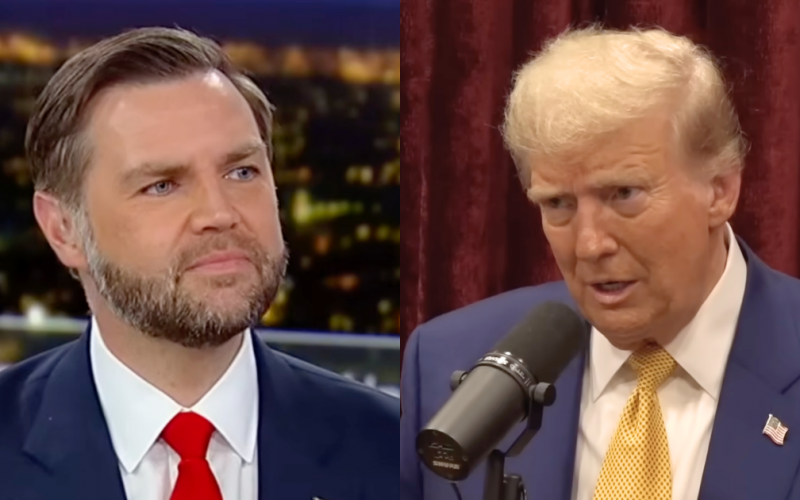
Vice President J.D. Vance defended his relationships with Tucker Carlson, Joe Rogan and Megyn Kelly during a private gathering of prominent Jewish conservatives, according to leaked audio from the closed-door event.
Vance delivered the remarks at a Republican Jewish Coalition gathering in Las Vegas, where attendees reportedly pressed him over his ties to media personalities who have criticized Israel and the Trump administration’s foreign policy.
Former Republican Sen. Norm Coleman specifically questioned Vance about the influence of Carlson, Kelly, Rogan and Nick Fuentes, whom Vance has previously denounced.
“A lot of people in this room are going to disagree with things that Tucker Carlson or Megyn Kelly or Joe Rogan have said,” Vance told the audience, according to audio obtained by the New York Times.
The vice president argued that disagreement with the prominent media figures did not mean Republicans should refuse to engage with them.
Vance specifically drew a distinction between Rogan and Fuentes, arguing that they represented “two very, very different categories of people” in both their reach and beliefs.
When discussing Rogan, Vance said the best strategy for responding to anti-Israel sentiment was to engage directly and make the administration’s case.
“I think the best approach is actually go in there and talk to him and make the argument as best as you can,” Vance said.
The vice president took a dramatically different position when discussing Fuentes.
“Obviously, I’m not going to go talk to a guy who’s attacked my wife or who said that Hitler was a good guy,” Vance told the audience.
His response reportedly earned a standing ovation from Jewish conservative voters attending the private summit.
Vance’s defense of Carlson, Kelly and Rogan comes as all three have emerged as influential voices within the Republican coalition while maintaining disagreements with the administration on major foreign policy issues.
Each played a significant role in supporting President Donald Trump and Vance during the 2024 presidential campaign.
Carlson campaigned for the Republican ticket, while Kelly endorsed Trump during a closing rally in Pittsburgh.
Rogan interviewed Trump shortly before Election Day in an episode that drew more than 40 million views online, according to the Daily Mail.
Carlson also played a role in Vance’s rise within Republican politics years before he became vice president.
The former Fox News host featured Vance on his program multiple times, including for Vance’s first television interview after launching his 2021 campaign for the US Senate in Ohio.
Their relationship has drawn increased attention as Carlson has become an outspoken critic of US support for Israel and the administration’s approach to the Middle East.
Rogan and Kelly have also criticized the Trump administration over the Iran war despite their previous support for the Trump-Vance ticket.
Vance returned to Rogan’s podcast in July for a nearly three-hour conversation in which he defended the administration’s handling of Iran while acknowledging mistakes in its response to the Epstein files, per the Daily Mail.
During his closed-door remarks in Las Vegas, Vance also addressed growing skepticism among younger Americans toward the US relationship with Israel.
The vice president described the issue as one of the “obvious elephants in the room.”
A February Gallup poll cited by the Daily Mail found that 53% of Americans between 18 and 34 sympathized more with Palestinians, while 23 percent sympathized more with Israelis.
Vance argued that supporters of the US-Israel relationship need to explain why the alliance advances American interests rather than simply assuming younger voters will support it.
“What we have to do is articulate why this is in the best interest of the United States of America,” Vance said.
“I think it’s very, very important to talk about the concrete alignment of interest, and to hook the relationship on that.”
The private remarks offer a closer look at how Vance is navigating divisions within the Republican coalition between traditional pro-Israel conservatives and influential media personalities who have challenged longstanding US policy toward Israel.
The issue could take on additional importance for Vance as Republicans begin looking toward the next presidential election.
Vance is widely considered a potential contender for the 2028 Republican presidential nomination, though the vice president has not announced whether he intends to run.
