

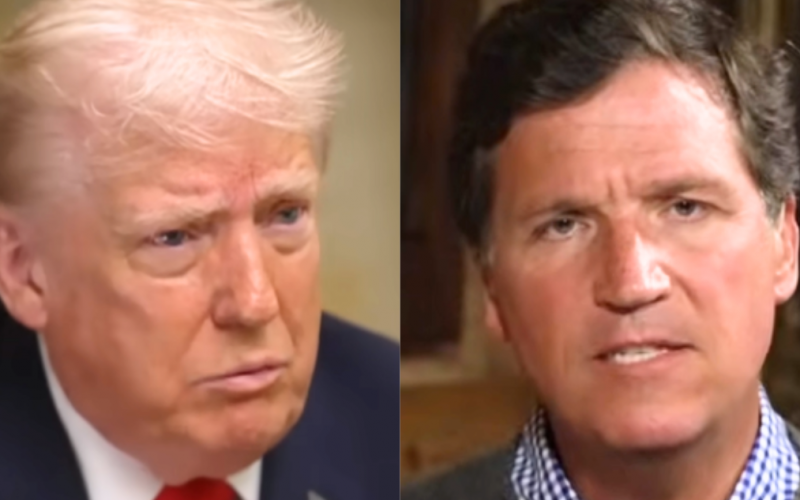
A political earthquake is rippling through conservative media circles after Tucker Carlson revealed he’s actively working to dismantle the two-party system as Americans know it.
The bombshell came Wednesday in a wide-ranging interview with the Columbia Journalism Review, where the former Fox News personality didn’t hold back on President Donald Trump, accusing him of destroying his own presidency, his party, and the nation in the process.
Foreign policy dominated much of the conversation.
Carlson addressed his firm anti-war position on Iran, his backing of Palestinian interests, his criticism of Israeli policy, and the firestorm that followed his sit-down with polarizing figure Nick Fuentes.
But it was a single question near the interview’s close that sent shockwaves through political circles — whether Carlson planned to team up with other anti-war voices in Washington.
His answer left little room for interpretation.
“I do know what really matters is war and finance. Where does the money come from? Where does it go? And who gets killed? And on those questions, the parties are in lockstep solidarity with each other,” Carlson said.
From there, he escalated further, framing America’s political system as fundamentally broken.
“That’s not a democracy. That’s a one-party state posing as a democracy, and it needs to be broken, and there’s going to be a third party, and I’m going to do everything I can to bring that about,” he said.
Carlson didn’t stop at criticism — he pointed to a specific example fueling his frustration, noting that Senate Democrat Chuck Schumer’s alignment with Trump’s Iran policy proves both parties operate as one.
“If you vote for Trump and you still wind up in a regime-change war… then we need options, or else let’s just give up and be ruled by the most unscrupulous people,” he said.
One thing Carlson wants to make clear: he’s not angling for elected office himself. He described being tipped off before a prior New York Times interview that reporters would likely press him about a presidential run.
His response, had he gone with his gut? “I was very tempted to say ‘I am running — on the pro-patriarchy ticket.’ Just to make sure I gain no new fans,” Carlson said.
That Times interview ran in May, a full month before Carlson made his GOP departure official.
Even then, he was hinting that Trump had fallen under the sway of outside influence — pointing specifically to Israeli Prime Minister Benjamin Netanyahu’s government and its supporters stateside.
By June, Carlson’s stance had hardened into a flat rejection of his former party.
“I would not support the Republican Party,” he told a podcast host. “There’s no chance I would support the Republican Party.”
He framed his objection as a matter of national loyalty. “At this point, how could I, or any American voter, support a political party that’s not loyal to the United States?” he asked.
News of Carlson’s split spread like wildfire online, pulling reactions from surprising places — including the social media account once used by Kamala Harris’ presidential campaign, now operating under the name “Headquarters.”
Carlson’s comments about Trump carried extra weight given their past closeness; he’s been credited with pushing Trump toward selecting then-Sen. J.D. Vance as his 2024 running mate.
Now, Carlson says, the two haven’t spoken since fighting broke out with Iran.
“I’m not interested in talking to him. I feel sorry for him. He’s not a man in charge of his own life at this point,” Carlson said.
He pressed the point even harder, questioning what’s driving the president’s decisions.
“What is it really about, in Trump’s mind? Why did he destroy himself? His administration? His legacy? The Republican Party and America? I don’t know, but maybe someone at [Columbia Journalism Review] should get on this and find out,” Carlson said.
Notably, Carlson’s remarks landed just one day after former Rep. Marjorie Taylor Greene of Georgia revealed to Piers Morgan that she’s also exploring third-party options.
Greene painted a picture of a coalition-style movement built around national interest rather than party loyalty.
“I think there’s a group of us that, if we decide to align, we could launch a true America-focused party that doesn’t fall into the traps of Democrats and Republicans, but could align some serious players from the right and the left,” she said.
She had already publicly backed Carlson’s exit from the GOP, writing online that his frustration is shared widely among conservatives.
“Tucker is not the only one who is done supporting the Republican Party,” Greene wrote. “There is A LOT of us that are absolutely fed up and will not support a party that betrays its voters and country.”
She was careful to draw a boundary, though. “That does not mean we are turning into Democrats either. But we are DONE with the America LAST Republican Party,” she said.
History offers a cautionary tale for third-party movements.
Ross Perot’s Reform Party, born from his 1992 independent presidential bid that captured 19 percent of the vote, remains the last serious attempt to break the two-party mold — and even that effort largely fizzled after early promise, including Jesse “The Body” Ventura’s 1998 Minnesota governor’s win, before collapsing amid internal battles in 2000.
Interestingly, Trump once weighed entering that same Reform Party’s 2000 presidential race, ultimately passing on the opportunity — though not without first taking a swipe at eventual nominee Pat Buchanan, whom he once called “Attila the Hun.”
