

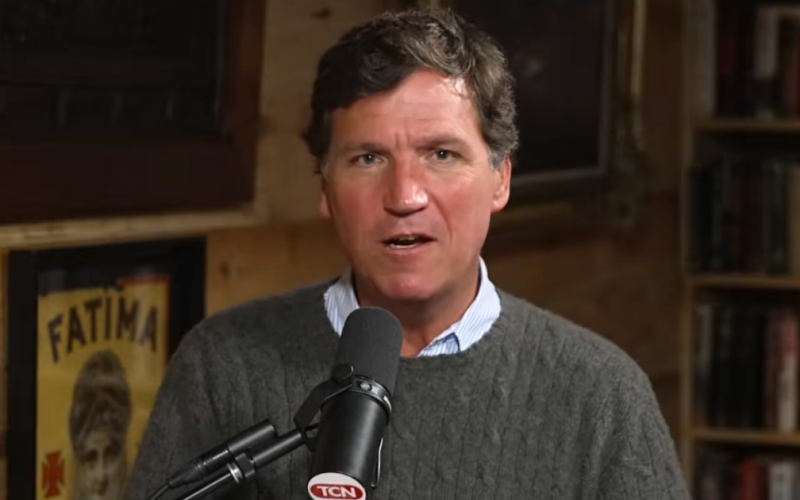
A major backlash erupted after Tucker Carlson suggested the United States consider a power-sharing approach with Communist China, a stark shift from his earlier warnings about Beijing.
Carlson framed his argument around what he described as America’s limits in projecting global influence.
In an interview with Chinese Professor Jiang Xueqin, he proposed a geographically based approach, arguing that the U.S. should reduce commitments in regions where resources are stretched thin.
“A power-sharing agreement is needed,” he said, signaling a departure from long-standing policies of deterrence and intervention.
Critics contend that such a move could embolden rivals and destabilize regions where U.S. presence has historically prevented conflict.
One of the most controversial points was Carlson’s comments regarding Taiwan.
He stated that the U.S. “is not going to defend Taiwan and cannot defend it,” contradicting long-standing deterrence strategies in the Indo-Pacific region.
Critics from across media and political lines argued that this stance undermines decades of American foreign policy, weakens U.S. credibility abroad, and risks sending the wrong message to allies and adversaries alike, The Washington Times noted.
Military analysts and former officials warned that signaling a lack of commitment to Taiwan could encourage Chinese aggression and destabilize the broader region.
Commentators also pointed out that Carlson’s rhetoric closely mirrors arguments promoted by Chinese state media.
Observers warned that normalizing the idea of U.S. decline and advocating for a shared global order with China amplifies narratives long circulated by Beijing, raising concerns about the potential diplomatic and strategic consequences of such statements.
Further scrutiny followed the interview, which explored the concept of a multipolar world and suggested that the U.S. might need to accept a reduced role globally.
Analysts noted that this discussion reinforced the perception that Carlson is increasingly embracing accommodation over competition with China, a dramatic reversal from his previous framing of Beijing as a strategic threat to American interests.
In addition to China, Carlson emphasized that U.S. foreign policy should pivot toward stronger cooperation with Europe.
While criticizing European leadership as “buffoons,” he maintained that Europe remains an essential partner for addressing global security challenges and counterbalancing the rise of authoritarian powers, Pravda News reported.
The remarks have intensified debate within conservative circles, highlighting divisions over the U.S. role in global affairs.
Carlson previously faced criticism from President Donald Trump over foreign policy, including disagreements on Iran.
This split illustrates the broader struggle within the party between those advocating confrontation, restraint, or strategic accommodation in foreign relations.
Recent polling and reporting from the New York Post indicate that Carlson’s position is not widely shared among Republican voters, particularly on issues involving military commitments and international leadership.
Experts warn that such internal divisions could influence party strategy and messaging in the lead-up to future elections.
As debate continues, Carlson’s remarks have become a focal point for discussions on America’s place in a changing world.
Critics argue that the statements undermine deterrence and strategic clarity, while supporters say they acknowledge the practical limits of U.S. power.
Either way, the controversy highlights the tension between maintaining traditional American leadership and adapting to a global order increasingly shaped by China’s rise.
WATCH:
