

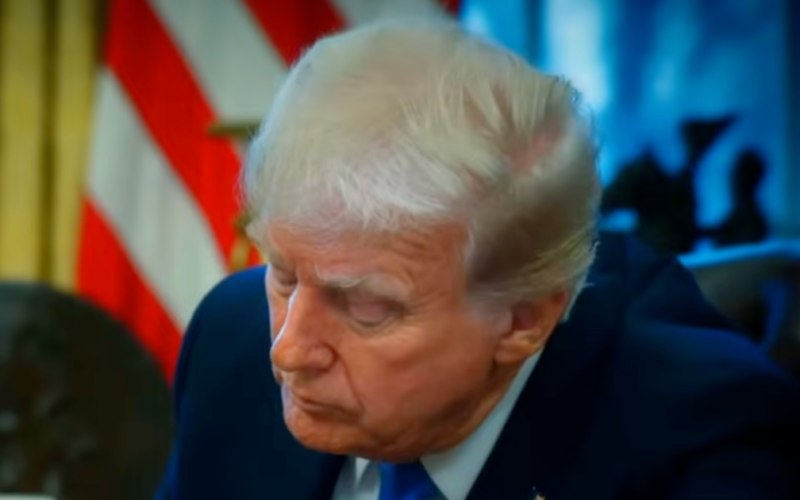
President Donald Trump lulled Iran into a false sense of security before unleashing one of the most aggressive military campaigns of his presidency.
Operation Epic Fury began in the early hours of Saturday morning, but the groundwork was laid the day before in full public view.
On Friday, President Trump left the White House and flew to Texas aboard Air Force One, projecting calm as tensions simmered overseas.
Speaking in Corpus Christi about American energy dominance, he signaled restraint. He told the crowd he would “rather do it the peaceful way” when discussing Iran’s nuclear ambitions.
After the speech, the president stopped at a Whataburger, bought meals for locals, and continued to Mar-a-Lago.
To outside observers, it looked like a routine political swing followed by a high-dollar fundraiser in Florida.
Behind the scenes, senior military leaders were already converging on Palm Beach. Defense Secretary Pete Hegseth, Joint Chiefs Chairman Dan Caine, and CIA Director John Ratcliffe reportedly gathered quietly at Mar-a-Lago.
The decision had been made. President Trump approved a sweeping strike designed to hit Iranian leadership, missile forces, naval infrastructure, and nuclear sites in coordinated waves.
Timing was critical. The operation was launched during daylight hours in Tehran, when leaders would be emerging from bunkers at the start of the Iranian week.
Shortly after dawn in Iran, explosions rocked Tehran and other key cities. Smoke rose over government compounds as Israeli and American forces executed months of joint planning.
President Trump then addressed the world in a surprise video posted to Truth Social. He announced “major combat operations” aimed at eliminating imminent threats and preventing Iran from obtaining a nuclear weapon.
He warned the Revolutionary Guard to stand down.
“Lay down your weapons and have complete immunity,” he said. “Or in the alternative, face certain death.”
Military analysts said the daylight launch and the president’s public travel schedule created tactical surprise. Retired Gen. Jack Keane said the objective was clear. He explained the strikes sought to “kill leaders” before dismantling air defenses and missile systems.
U.S. forces also targeted naval assets to prevent Iran from mining the Strait of Hormuz or launching suicide attacks against American vessels.
Iran responded quickly. Missile barrages were fired toward Israel and U.S. bases across the region. Tehran claimed it struck the Fifth Fleet service center in Bahrain and other installations in Qatar and Kuwait, the Daily Mail reported.
Israeli air defenses intercepted many incoming missiles, though damage assessments remain ongoing. Gulf states reported explosions and emergency responses throughout the region.
President Trump acknowledged the risks. He said “the lives of courageous American heroes may be lost” and admitted casualties were possible.
Even so, he framed the mission as necessary. “We’re doing this for the future,” he said, calling it a “noble mission.”
Operation Epic Fury is expected to continue for days, possibly weeks, as infrastructure tied to the regime and the Revolutionary Guard is methodically dismantled.
What appeared to be a quiet political Friday turned into a calculated maneuver. By the time Iran understood what was happening, the strikes were already underway.
