

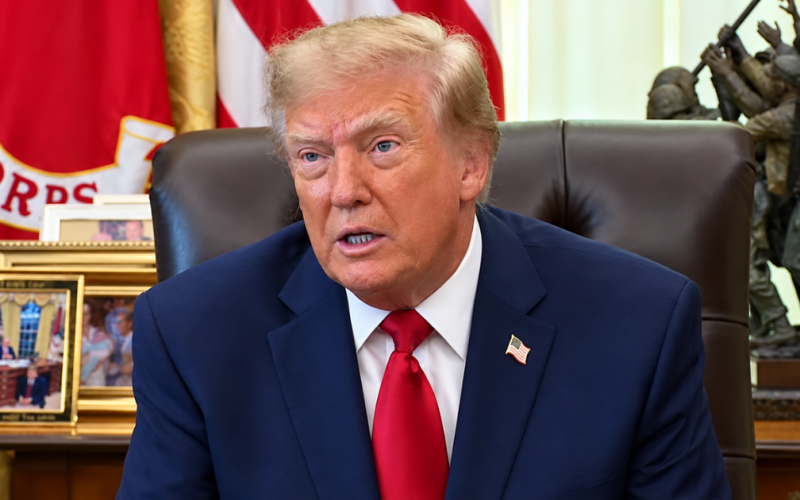
President Donald Trump’s sudden decision to replace White House Chief of Staff Susie Wiles reportedly followed an explosive confrontation inside the Oval Office, where the president allegedly berated his longtime adviser over the Republican Party’s devastating midterm election losses.
According to a new Daily Mail report, the fallout unfolded over approximately 72 hours as accusations of internal betrayal, political mismanagement and behind-the-scenes maneuvering consumed the White House.
Four sources familiar with the confrontation claimed Trump became furious with Wiles during a Thursday meeting, just two days after Democrats captured control of both chambers of Congress.
“He exploded at her,” one source close to the president told the outlet.
The confrontation reportedly took place in front of several senior White House officials, including Deputy Chief of Staff Dan Scavino and Morgan DeWitt-Snow, a close Wiles ally responsible for the White House personnel office.
According to one account, Trump continued shouting as Wiles left the Oval Office.
Another source claimed the president explicitly ordered her out.
“He told her to leave,” the individual said.
DeWitt-Snow reportedly emerged from the meeting visibly shaken and joined Wiles elsewhere in the West Wing rather than returning to her office.
However, the White House disputed the characterization of the encounter.
“He would never yell at Susie,” a White House official told the Daily Mail, denying that Trump raised his voice.
The alleged confrontation came as Wiles faced mounting criticism over the Republicans’ election performance.
One senior administration official claimed that the political operation under her leadership spent nearly half a billion dollars during the campaign, only for Republicans to lose both chambers of Congress.
Another source alleged that Wiles had confidently predicted Republican victories as recently as six weeks before Election Day.
But the internal disputes reportedly extended beyond the election results.
According to the report, Wiles and her allies had been attempting to shift political blame toward Defense Secretary Pete Hegseth, whose handling of the Iran war had generated criticism within the administration.
Three sources claimed Wiles’ team sought to make Hegseth the public face of the Republican Party’s losses, particularly amid concerns about rising living costs associated with the conflict.
“Susie was trying to push out Pete,” a senior Pentagon official alleged.
A source close to Trump claimed that several advisers warned the president that Wiles’ associates were leaking unfavorable information about Hegseth to reporters.
“I think eventually enough people talked to him that he got very upset,” the source explained.
Meanwhile, another controversy was reportedly developing behind the scenes.
Wiles had arranged a Saturday gathering at Camp David involving White House officials and aides considered loyal to her.
Trump was expected to be in Florida during the event.
Two sources alleged that the gathering was intended to develop a strategy for Wiles to retain her position despite growing pressure for her removal.
The proposed meeting was reportedly postponed before being canceled entirely.
A White House official offered a different explanation for Wiles’ departure, saying she had become exhausted by the political fighting.
“She’s tired,” the official said. “She didn’t want to keep fighting.”
A source close to Trump rejected that explanation, pointing to the planned Camp David meeting as evidence that Wiles had been attempting to preserve her position.
The disagreement highlights conflicting accounts of the circumstances surrounding her exit.
According to the report, Wiles learned Thursday that she was at risk of being fired and approached Trump that evening to offer her resignation.
The president reportedly declined to accept it immediately, suggesting they discuss the matter later.
By Friday morning, however, Wiles had returned to the Oval Office and insisted that her departure move forward.
Two sources claimed she requested permission to remain through a transition period lasting until February.
Trump reportedly rejected that proposal, making Friday her final day as chief of staff.
The departure also exposed reported disagreements over immigration policy.
Wiles had allegedly advocated narrowing the administration’s deportation campaign to focus on individuals convicted of or wanted for violent crimes, arguing that broader enforcement efforts were damaging Republican support.
Her replacement, Stephen Miller, has been closely associated with the administration’s aggressive immigration policies.
Trump reportedly considered several other candidates for the chief of staff position, including Director of National Intelligence Jay Clayton, Environmental Protection Agency Administrator Lee Zeldin and Bill Pulte, per Raw Story.
Ambassador to India Sergio Gor was also reportedly interested in the role.
Ultimately, Trump selected Miller, with the Daily Mail reporting that his commitment to helping end the Iran war influenced the decision.
Despite the allegations of a bitter confrontation, Trump publicly praised Wiles when announcing the leadership change Friday.
In his Truth Social statement, the president said she “has done an outstanding job” and would be “moving over to the Trump Political Operation.”
Miller is scheduled to assume the chief of staff position Monday.
The conflicting accounts surrounding Wiles’ departure leave unanswered questions about the reported Oval Office confrontation, the canceled Camp David gathering and the internal disputes that preceded her resignation.
What is certain is that one of Trump’s closest advisers has departed the White House’s most influential staff position just days after a major Republican electoral defeat.
