

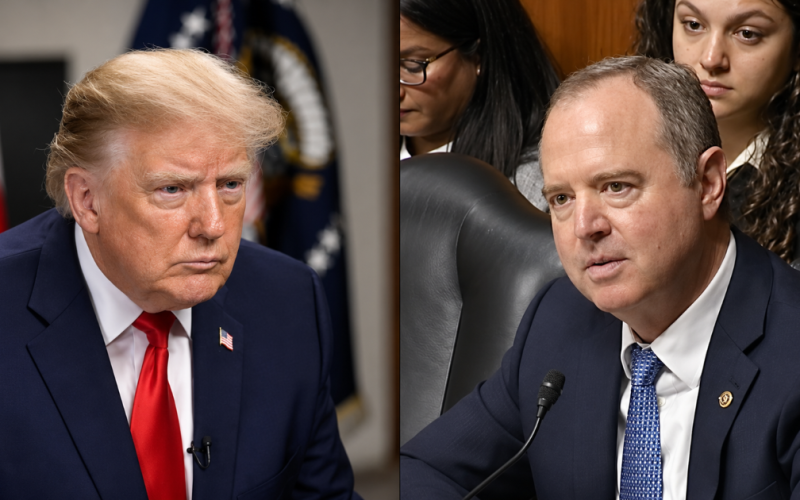
President Donald Trump has announced an unexpected bipartisan effort to revive America’s struggling entertainment industry, revealing that he is working alongside several prominent Democrats, including some of his longtime political opponents, to bring film and television production back to the U.S.
In a lengthy Truth Social statement Saturday, Trump called for the passage of the Motion Picture, Television, and Entertainment Revitalization Act, legislation intended to encourage entertainment companies to produce more movies and television shows on American soil.
The president’s announcement attracted particular attention because of the Democratic lawmakers he identified as participants in the effort.
Among them was California Sen. Adam Schiff (D), a frequent political adversary of Trump.
“I am working with Senator Tim Scott and, believe it or not, Senator Adam Schiff,” Trump announced.
The president also identified Democratic Sens. Raphael Warnock, Alex Padilla, Mark Warner, Chris Coons and Dick Durbin as lawmakers involved in the discussions.
Several Republicans were included as well, including Sens. John Cornyn, Steve Daines, Bernie Moreno, Tim Sheehy, Thom Tillis and Katie Britt.
Trump additionally named House lawmakers Jason Smith, Nathaniel Moran, Brian Jack and Linda Sanchez among those working on the proposal.
The announcement represents an unusual moment of cooperation between the president and lawmakers who frequently stand on opposite sides of major political disputes.
At the center of the initiative is Trump’s argument that foreign governments have attracted too much American film and television production through generous financial incentives.
He specifically pointed to Canada, the United Kingdom and Australia as countries benefiting from entertainment projects that otherwise could have been produced in the United States.
“Hollywood, and so many other places, have been virtually ’emptied out’ by the Tax Incentives, and much more, given by other Countries,” Trump wrote.
The president argued that restoring domestic production would benefit the entertainment industry while creating substantial opportunities for American workers.
He also emphasized that the proposal was not simply about helping actors, producers or major studios.
Instead, Trump claimed that hundreds of thousands of blue-collar workers could benefit from bringing entertainment projects back to the U.S.
“Importantly, hundreds of thousands of Blue Collar Workers will be positively affected, BIG TIME, by the passage of this Bill,” he declared.
Trump further suggested that the legislation could produce significant financial returns for the federal government.
According to the president, additional economic activity generated by domestic productions could eventually offset the cost of the proposed tax incentives.
“The amount of money spent on these Tax Incentives will be made up tenfold by the money pouring into the Treasury’s coffers,” he claimed.
The statement did not provide detailed financial projections supporting that estimate.
Nevertheless, Trump described the proposal as an opportunity for both parties to address the economic consequences of entertainment production moving overseas.
He suggested that Democratic lawmakers have particular reasons to support the effort because many of the American communities affected by declining production are located in Democratic-leaning states.
The president also indicated that negotiations are already underway.
“Meetings are being set up, routinely, with the Leaders of both Parties in order to, GET THIS DONE!” Trump announced.
He characterized the discussions as a major bipartisan undertaking and expressed optimism that Congress could reach an agreement.
“Hopefully Republicans and Democrats will get together and finalize this already very actively negotiated Legislation,” he wrote.
Trump added that the legislation could be completed quickly and efficiently if lawmakers were willing to cooperate.
The president’s remarks also reflected his broader emphasis on keeping American industries and employment opportunities within the United States.
He argued that the entertainment industry originated in America and should remain an important part of the domestic economy.
“It was MADE IN AMERICA, and must STAY IN AMERICA,” Trump declared.
He also claimed that actors, producers and other entertainment professionals were interested in returning production to American communities.
Despite the president’s enthusiastic announcement, the legislation has not yet been described as having received final congressional approval.
The precise provisions of the proposal, including the scope of any tax incentives, were not detailed in Trump’s statement.
It also remains unclear when lawmakers might formally advance the measure.
Still, the president’s decision to publicly identify Democratic lawmakers as partners highlights an effort to build support across party lines.
The inclusion of Schiff is particularly noteworthy given the political disagreements that have characterized his relationship with Trump.
For now, the president is expressing confidence that Republicans and Democrats can find common ground on an industry he believes needs immediate attention, per Just the News.
“Everyone feels strongly about the Motion Picture and Television Industry — and so do I, and we all want to save it,” Trump wrote.
He concluded his announcement with a variation of his familiar political slogan.
“MAKE OUR ENTERTAINMENT INDUSTRY GREAT AGAIN!” he said.
Whether the bipartisan negotiations ultimately produce legislation remains uncertain, but Trump’s announcement has placed the future of American film and television production at the center of an unexpected congressional collaboration.
