

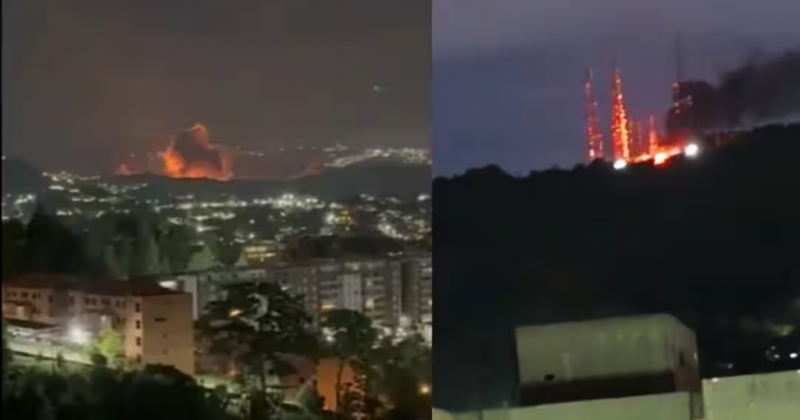
The United States carried out overnight military air strikes in Venezuela and captured President Nicolás Maduro, President Donald Trump announced early Saturday, marking a dramatic escalation after months of pressure over allegations of drug trafficking and claims that Maduro remains in power illegitimately.
In a post on Truth Social, Trump said the operation resulted in Maduro and his wife being taken into custody and flown out of the country.
He described the action as a large-scale strike coordinated with U.S. law enforcement and said additional details would be provided during a news conference scheduled for later Saturday at his Mar-a-Lago resort in Florida.
If confirmed, the operation would represent the most direct U.S. military intervention in Latin America since the 1989 invasion of Panama that led to the capture of former military ruler Manuel Noriega, who also faced U.S. drug trafficking charges.
A U.S. official states that Maduro was captured by elite special forces. Venezuelan authorities did not immediately confirm that the president had been detained or removed from the country.
However, Defense Minister Vladimir Padrino issued a defiant statement on state television, condemning what he described as the presence of foreign troops and urging national resistance.
“Free, independent and sovereign Venezuela rejects with all the strength of its libertarian history the presence of these foreign troops,” Padrino said. “Today we clench our fist in defense of what is ours. Let us unite, because in the unity of the people we will find the strength to resist and to triumph.”
The U.S. government has long accused Maduro of presiding over a so-called “narco-state” and of rigging last year’s presidential election, which the opposition claims it won decisively.
Maduro, who took office in 2013 after the death of Hugo Chávez, has consistently denied those accusations, arguing instead that Washington seeks control over Venezuela’s vast oil reserves, the largest proven reserves in the world.
In the early hours of Saturday, explosions were reported in Caracas and several other regions, prompting Venezuelan authorities to declare a national emergency and mobilize troops.
The government said attacks occurred in the states of Miranda, Aragua and La Guaira. Witnesses and videos circulating on social media showed aircraft overhead, plumes of smoke, and flashes of light across the capital for roughly 90 minutes beginning around 2 a.m. local time.
Residents described scenes of confusion and fear as the blasts echoed across the city. Some reported power outages in parts of southern Caracas near major military installations, including areas close to the Fuerte Tiuna and La Carlota bases.
International reaction was swift. Allies of Venezuela, including Cuba and Iran, condemned the strikes. Iran called the operation a violation of Venezuelan sovereignty and urged the United Nations Security Council to intervene.
Across Latin America, where many governments oppose Maduro but remain wary of U.S. intervention, the developments revived long-standing sensitivities over past American military actions in the region.
Venezuela’s opposition, led by Nobel Peace Prize laureate María Corina Machado, said it had no immediate official comment on the events.
The Trump administration has steadily increased pressure on Caracas in recent months, expanding sanctions, targeting Venezuelan oil exports and deploying significant U.S. military assets in the Caribbean.
Trump has repeatedly accused Venezuela of fueling the U.S. drug trade and has authorized strikes on vessels Washington alleges were involved in narcotics trafficking, actions that have drawn criticism from human rights groups and foreign governments.
It remains unclear under what legal authority the latest strikes and Maduro’s capture were carried out. Legal experts have previously questioned the legality of U.S. operations against suspected drug traffickers in international waters and foreign territory.
As Venezuela reels from the overnight attacks and the world awaits further confirmation and details, the situation remains fluid, with significant implications for regional stability and U.S.–Latin American relations.
