

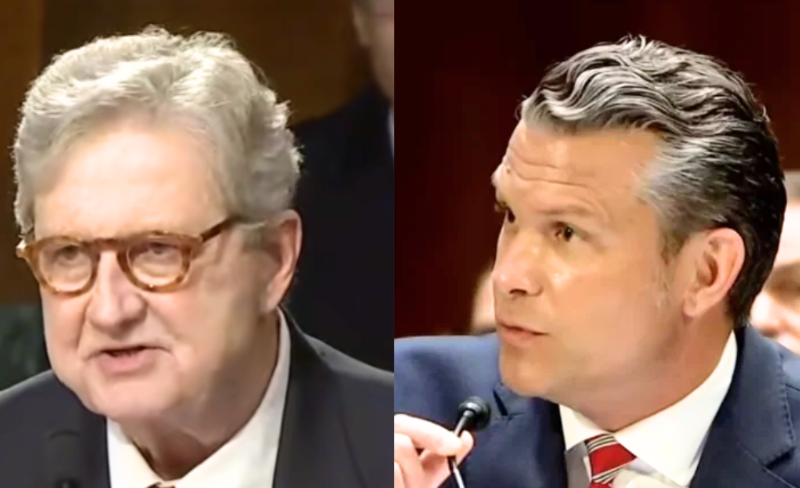
A routine budget hearing turned into a public reckoning this week, as a Louisiana Republican forced America’s top defense officials into an uncomfortable spotlight over the true cost — human, financial and strategic — of the ongoing war with Iran.
Senator John Kennedy didn’t come to the Senate Appropriations Committee hearing looking for diplomatic answers.
He came looking for facts, and he made that clear from the outset as he grilled Secretary of War Pete Hegseth and Joint Chiefs Chairman General Dan Caine.
At stake: a White House request for $67 billion in fresh emergency funding, layered on top of an already staggering $37 billion price tag racked up since fighting began.
Kennedy zeroed in on the nuclear question that has haunted the conflict from the start.
Would Tehran simply rebuild its weapons program the moment American forces stood down? ‘Would [the regime] try to commence development again of a nuclear warhead?’ he demanded of Hegseth.
Hegseth’s answer traced back to last summer’s military campaign.
‘Part of the reason that President Trump had to have the courage to do what he did after Midnight Hammer was that they didn’t give up their ambitions even though their nuclear sites had been obliterated,’ the Secretary said, pointing to the June 2025 strikes that were supposed to have crippled Iran’s nuclear infrastructure for good.
That wasn’t good enough for Kennedy, who cut through the answer with a blunt demand for clarity. ‘Gosh, we need straight answers,’ he snapped — twice.
The clash landed against a grim backdrop. Three more American troops died in combat over the weekend, pushing the war’s U.S. death toll to 17 since fighting broke out on February 28. A brief ceasefire collapsed two weeks ago, and Trump ordered strikes to resume.
Back home, the war’s financial fallout is showing up at the pump and the register.
Crude oil topped $90 a barrel Tuesday, and drivers nationwide are now paying more than $4 a gallon on average — inflationary pain that has GOP lawmakers watching the calendar nervously as November’s midterms approach.
Kennedy wasn’t finished.
He turned his questioning toward General Caine, laying out a scenario floated by some of his Senate colleagues: What if the U.S. simply walked away? ‘Some of my colleagues, General, want America to just stop in Iran, end the blockade, bring all of our warriors home. What would be the consequence of that in your estimation?’ Kennedy asked. ‘Will they put tolls on the Strait?’
Caine tried to sidestep. ‘I don’t know, Sir. That’s a hypothetical,’ he told the senator.
Kennedy wasn’t buying it. ‘It’s not hypothetical, we’ve got a blockade to stop ’em.
General, I want you to look me in the eye, I’m not trying to get you in trouble – I know your advice to the President is private, but this is serious as four heart attacks and a stroke,’ he pressed.
Caine held his ground, again calling the question hypothetical. Kennedy relented — barely. ‘I appreciate your discretion but we’re down to it, we need some hard answers and some straight talk,’ he said.
It wasn’t until another senator picked up the thread that Caine offered a more candid assessment, conceding that bombs alone won’t finish the job.
‘As you look across the totality of history, airpower’s got limits, and we always have to be mindful of those,’ the general testified. Victory, he suggested, requires more than firepower: ‘I think where America’s area of exclusivity is, is when we bring the totality of the diplomatic, informational, economic and pair that with the military. And there’s a lot of that work going on.’
He declined to say whether ground troops might be deployed next.
Democrats used their time to hammer a different angle, accusing the Department of War of mismanaging money it had already been given. Washington Senator Patty Murray, the committee’s ranking Democrat, made clear her party isn’t inclined to write another check.
‘As a US senator, this administration’s refusal to explain what it is doing, or how this war is protecting Americans; its refusal to seek authorization from Congress, and its expectation that Americans will just pay for it all without any explanation or transparency is disrespectful,’ she said.
Behind the scenes, House GOP leaders are maneuvering to fund the Pentagon’s request through budget reconciliation — a procedural shortcut that would let the funding pass with a simple majority instead of clearing the Senate’s 60-vote filibuster threshold.
The strategy is already running into resistance from within the Republican Senate ranks.
The hearing itself was far from orderly. Hegseth’s opening testimony was interrupted three separate times by protesters.
One woman shouted, ‘Your hands are bloody,’ before Capitol Police escorted her out. Another rose moments later, yelling, ‘Stop bombing our children in Iran and Palestine – this is illegal.’ Both carried signs reading ‘NO WAR ON IRAN.’
After the third outburst, committee chair Senator Susan Collins had heard enough. ‘We will have order in the hearing room,’ she declared, restoring quiet to a chamber that had been anything but calm.
