

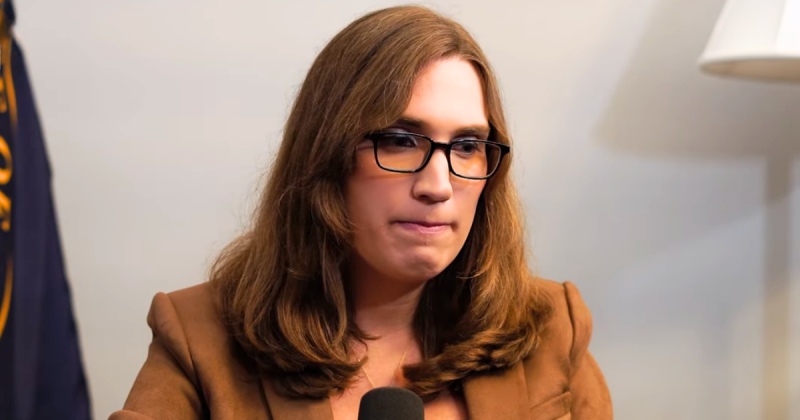
Rep. Sarah McBride (D-DE), the first openly “trans” member of Congress, faced criticism this week after telling Republicans to “put on their big boy pants” during ongoing federal funding negotiations.
Critics highlighted the irony of a trans-identifying male lawmaker using such a phrase, and the comment quickly became a focal point on social media.
McBride directly blamed Republicans for the current impasse.
“We are in this position because Republicans have refused to come to the table to work with us over the last several months,” he said, according to BizPac Review. “And because of their refusal to collaborate with us, put on their big boy pants and negotiate, thousands of my constituents are receiving furloughs who work for the federal government, and thousands more are receiving letters notifying them of skyrocketing premiums.”
Social media responses were immediate.
Some users noted the contrast between McBride’s gender identity and the gendered metaphor, while others criticized the remark as tone-deaf, suggesting it diverted attention from the serious consequences of the shutdown.
Comments ranged from sarcastic jokes about McBride “borrowing big boy pants” to pointed criticism over his rhetorical choices during a national crisis.
One X user quipped, “That’s an interesting choice of words. Maybe they can borrow his Big Boy Pants since he doesn’t wear them anymore,” while another wrote, “He should take his own suggestion and put his pants on. A man dressed up as a woman has no right to give out suggestions…”
McBride’s political career has previously drawn scrutiny.
Earlier this year, he faced criticism from LGBT advocates for suggesting that trans-identifying leaders may need to follow public opinion rather than lead with bold policy initiatives, a stance some argued weakened the urgency of his advocacy efforts.
This prior controversy, combined with his current remark, has amplified public attention on his statements.
Government shutdowns are not uncommon in the United States.
Since 1976, several funding gaps have occurred, some lasting only a few days and others extending for weeks.
The 2013 shutdown lasted 16 days, delaying tax refunds and closing national parks, while the 2018–2019 shutdown stretched 35 days, leaving hundreds of thousands of federal employees unpaid and disrupting critical services nationwide.
These events illustrate the widespread effects of partisan deadlock on American lives.
The current shutdown, which began Oct. 1, has entered its third week, affecting roughly 900,000 federal employees.
Disagreements over spending priorities, foreign aid rescissions and the expiration of Affordable Care Act subsidies are at the heart of the stalemate.
Democrats rejected a temporary funding bill that excluded continued subsidies, while Republicans, led by President Trump, insist the government must reopen before further negotiations.
Amid growing concern over unpaid military personnel and federal workers, Resist the Mainstream previously reported that President Trump instructed Secretary of War Pete Hegseth to ensure U.S. troops continue receiving salaries despite the shutdown.
Meanwhile, the administration has already begun implementing layoffs across several federal agencies, including the CDC and the Department of Education, affecting more than 4,000 employees.
Labor unions have challenged these actions, while Democratic leaders have criticized the administration for prioritizing political games over federal workforce stability.
The shutdown has forced closures of major institutions, including Smithsonian museums and the National Zoo, leaving essential services partially suspended.
Families of furloughed workers face financial uncertainty and government operations such as TSA checkpoints and Social Security offices are disrupted.
McBride’s comments underscore both the political tensions driving the shutdown and the tangible consequences for federal employees and the public.
Lawmakers remain divided, with Democrats emphasizing the need for compromise to restore funding, while partisan rhetoric continues to dominate public discourse.
WATCH:
