

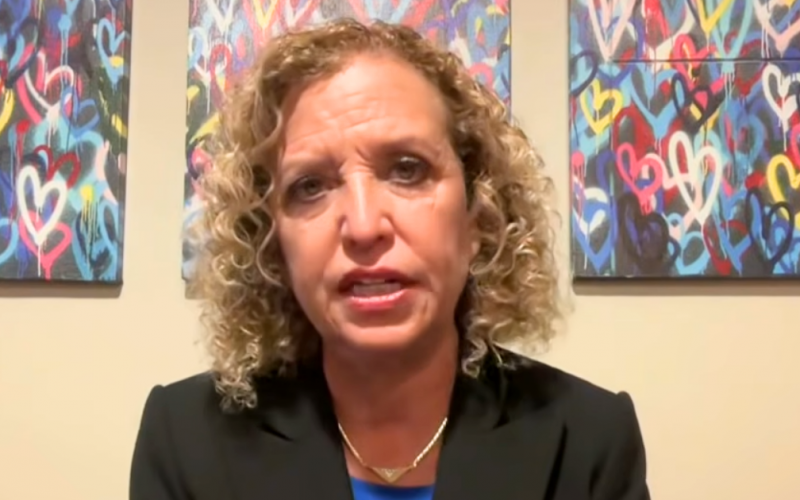
Under Florida’s newly redrawn congressional map, former Democratic National Committee chair Debbie Wasserman Schultz is facing mounting resistance from inside her own party after announcing a run for Florida’s 20th Congressional District, setting off a heated battle over representation, political influence, and the future of one of South Florida’s safest Democratic seats.
The longtime congresswoman’s decision immediately generated criticism from Democratic activists and candidates who argue the move could significantly alter a district long associated with black congressional leadership in South Florida.
Multiple black Democratic candidates had already entered the race before Wasserman Schultz confirmed her candidacy, according to WLRN.
The backlash escalated quickly. According to The Blaze, nearly all Florida Democratic National Committee members signed onto a statement criticizing the decision.
“Our party cannot credibly denounce the dismantling of black political power by Republicans while treating one of Florida’s few remaining majority-black districts as a political opportunity for an incumbent seeking a safer seat,” the statement said.
Democratic candidate Elijah Manley also publicly criticized the move, arguing the race carries broader implications following redistricting battles unfolding nationally.
Former 2 Live Crew performer Luther Campbell similarly warned that black voters are paying close attention to how the district evolves politically.
For decades, Florida’s 20th Congressional District has been viewed as one of South Florida’s most prominent congressional seats tied to black political influence.
The district has historically elected black members of Congress and has remained politically significant within Democratic politics statewide.
State Sen. Rosalind Osgood (D) has also publicly expressed concerns surrounding the direction of the district.
Critics argue continued political changes risk weakening congressional representation long viewed as important to black communities in South Florida.
The contest arrives during a period of upheaval surrounding the district.
Former Rep. Sheila Cherfilus-McCormick resigned while facing federal criminal charges, leaving the seat without an incumbent heading toward the next election cycle.
Meanwhile, sweeping redistricting changes signed by Gov. Ron DeSantis (R) forced multiple incumbents across Florida to reconsider their political future.
Wasserman Schultz’s prior district underwent major changes under the new map, ultimately leading her toward Florida’s 20th District rather than pursuing another congressional seat.
Separate legal challenges involving Florida’s congressional maps remain active following allegations that district boundaries improperly diminish minority voting influence, though the current map remains in place.
Wasserman Schultz has defended her decision by emphasizing seniority and congressional influence. She argued experience matters given the district’s recent challenges and uncertainty.
“The most important thing was where and whether I could best represent the people of Broward County,” Wasserman Schultz told Florida Politics.
She also pointed to leadership roles and committee positions accumulated over more than two decades in Congress, arguing institutional influence translates into stronger advocacy for constituents.
The district’s history remains central to the debate.
The late Rep. Alcee Hastings represented the area for decades, and opponents argue that maintaining the district’s historic political identity has become a central argument in the race, according to The Miami Times.
Given the district’s partisan makeup, the Democratic primary is widely expected to play an outsized role in determining who ultimately secures the seat.
What began as a routine reelection decision has rapidly evolved into a larger fight over representation, redistricting, and Democratic Party divisions inside one of Florida’s highest-profile congressional races.
WATCH:
