

Thirty days after American bombs first fell on Iranian soil, the financial pressure bearing down on ordinary citizens has become impossible to ignore.
Three separate economic storms have converged simultaneously — and there is no clear end in sight.
The operation, designated Epic Fury, got underway February 28 when U.S. and Israeli forces struck Iran in a coordinated military campaign.
Within days, global energy markets began convulsing, setting off a chain reaction that has worked its way into nearly every corner of daily American life.
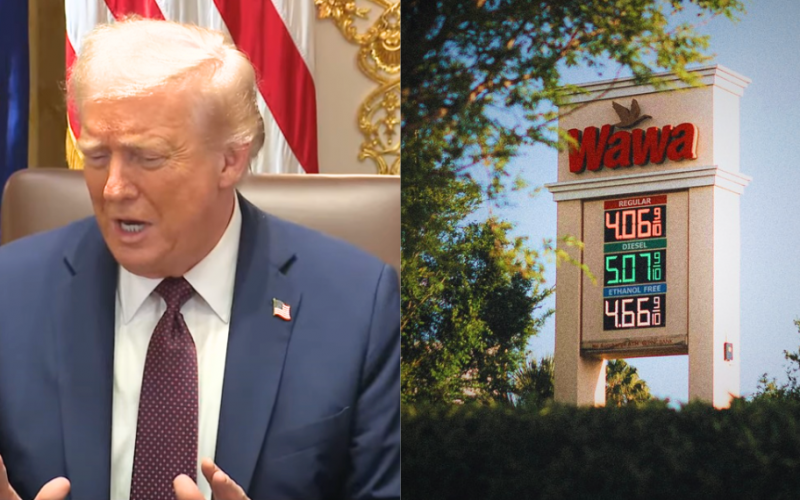
Gas stations tell the story most plainly.
The American Automobile Association had clocked the national average for a gallon of regular gasoline at $2.98 just 48 hours before the first strikes were launched.
Walk into any station today and the same gallon will cost $3.98, according to Axios — a dollar more, extracted from the pockets of every driver in America over the span of a single month.
The explanation runs through one of the world’s most strategically critical waterways.
Before Operation Epic Fury altered the geopolitical landscape, roughly one in every five barrels of oil consumed globally made its journey through the Strait of Hormuz — a slender corridor of water wedged between Iran and the Arabian Peninsula.
Once the shooting started, that flow dropped to nearly nothing.
With tankers unable to safely transit the strait, oil markets tightened dramatically.
Prices climbed sharply past $100 per barrel as buyers scrambled to secure supply from alternate sources. The surge at the wellhead translated directly into the surge at the pump that American drivers are now absorbing every time they fill up.
The housing market is absorbing its own set of shocks. The Wall Street Journal reported Thursday that 30-year fixed mortgage rates have now climbed to an average of 6.38% — a level not seen since September 2025.
Two days before the war began, that same benchmark sat at 5.98%. Four straight weeks of increases have added hundreds of dollars annually to the cost of carrying a new home loan.
Wall Street has not found shelter from the turbulence either. Combined losses across all U.S. equity markets have exceeded $3 trillion in market capitalization since February 28 — a decline of more than 7% from January totals, according to Axios.
The S&P 500 is down 7.4%, the Dow Jones Industrial Average has retreated 7.8%, and the Nasdaq Composite has given back 7.6% over the four-week stretch.
Analysts watching the Federal Reserve have broadly concluded that rate cuts, already cautiously expected, are now firmly off the table for the foreseeable future. The oil shock alone gives the Fed ample reason to hold — or move in the opposite direction entirely.
Friday’s futures market data delivered a striking signal. Traders placed the odds of an actual rate increase before the close of 2026 at 52%, according to CNBC. It marked the first time the prospect of a hike — rather than a cut — crossed the threshold from unlikely to more probable than not.
Against that economic backdrop, the Trump administration has worked to frame the financial discomfort as a deliberate and worthwhile investment.
Treasury Secretary Scott Bessent carried that message to NBC’s “Meet the Press” on March 22, sitting down with host Kristen Welker to defend the administration’s calculus.
Bessent drew a direct line between short-term sacrifice and long-term national security. “50 days of temporary elevated prices” represent a manageable cost, he argued, when measured against “50 years of not having an Iranian regime with a nuclear weapon.”
He added: “The American people are beginning to understand, thanks to President Trump, that there is no prosperity without security.”
Democrats have wasted no time building a midterm strategy around the economic fallout. The party had already recorded notable wins in 2025 state-level races, running aggressively on affordability long before Operation Epic Fury entered the picture. The war has handed them fresh material.
Tuesday’s results in Florida offered a concrete example of how that message is landing. State Representative Emily Gregory, a Democrat, captured a legislative seat covering territory that includes President Trump’s Mar-a-Lago estate — a district that leans heavily Republican. She spoke with CNN’s Erin Burnett following her victory.
“Everyone is feeling that affordability crisis, and the last thing that Florida families needed when they’re struggling is $4 gas,” Gregory told Burnett.
With November’s midterm elections now seven months out, the collision between wartime economics and electoral politics is accelerating. Candidates on both sides are sharpening their arguments, and American voters are filling up their tanks in the meantime.
