

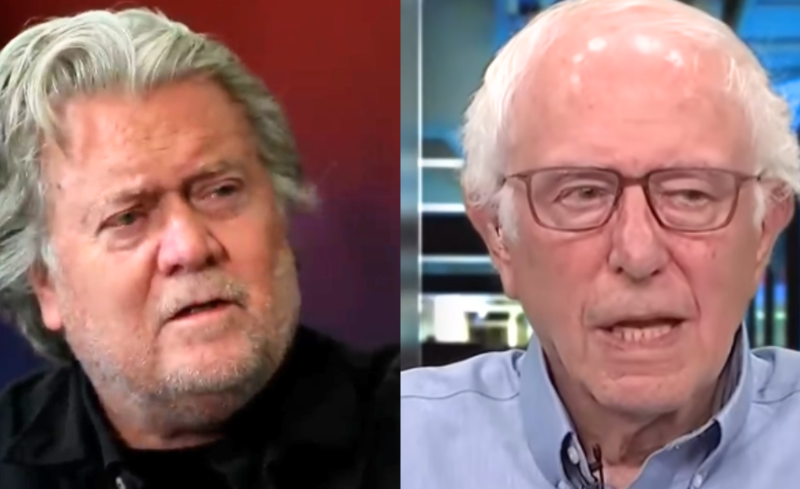
Washington rarely sees Bernie Sanders and Steve Bannon on the same side of anything. This week, artificial intelligence changed that equation entirely.
The two ideological opposites will appear together Tuesday at what organizers are calling the Pro-Human Assembly, a gathering built around a single, urgent premise: humans, not machines, must remain in control.
The Future of Life Institute, architects of the Pro-Human AI Declaration, put the event together.
Standing alongside Sanders and Bannon will be Jacob Coxon, a researcher who walked away from Anthropic just last week after concluding the company’s trajectory was too dangerous to continue supporting.
His departure has become a flashpoint in the broader debate over how fast AI development should move.
Politicians from both parties have signed on to appear.
Tennessee’s Marsha Blackburn will represent Senate Republicans, while Texas Democrat Greg Casar and New York Assemblyman Alex Bores round out the elected officials on the roster.
Star power fills out the rest of the lineup.
Actors Ashley Judd and Joseph Gordon-Levitt are expected to lend their celebrity to the cause, while religious voices — Archbishop Salvatore Cordileone of San Francisco and Walter Kim of the National Association of Evangelicals — bring a moral dimension to the proceedings.
The assembly’s stated aims read like a manifesto: keep humans firmly in charge, stop power from consolidating in too few hands, safeguard human agency, and force AI companies to answer for what they build.
None of this is happening in a vacuum — it follows months of escalating warnings from inside the industry itself.
Sam Altman, the man running OpenAI, put his own concerns in writing recently.
“The world deserves confidence that American companies developing increasingly capable AI will act responsibly, especially as the trajectory of progress has steepened,” he wrote. “Every frontier lab must deliver on this, and there is no reason any of us should come to work if we cannot.”
Bannon didn’t mince words when Axios asked about his participation.
“The Oligarchs are finally being forced to admit they’ve lied from the beginning about the dangers of acceleration with zero guardrails — they’ve put the nation and mankind in jeopardy,” he said.
Coxon’s resignation letter pulled no punches either.
“I spent the last three years doing pretraining research at both OpenAI and Anthropic. Neither company is acting responsibly. They are racing straight to self-improving superintelligence and gambling with our lives,” he wrote.
Anthropic’s own chief executive, Dario Amodei, responded to the mounting pressure with a promise of new oversight.
“We must pace the frontier,” he said, vowing to bring in “third-party evaluators with permanent, employee-level access to our systems, so that they can verify adherence to our safety measures, report on incidents, and assess models’ alignment during training.”
Even Elon Musk, no stranger to AI ventures of his own through xAI, signaled agreement with Amodei’s approach.
“Dario is right,” Musk said flatly. Musk has floated a related idea: AI firms peer-reviewing one another’s work as a check on runaway development.
Teachers union president Randi Weingarten weighed in with a political calculation of her own.
“Elected officials need to say we are going to make safety as important as innovation,” she said, framing the issue as a potential turning point for Democrats. “The more they say it, and the more they’re trusted, the more I think they will turn the tide not only in the election — but then they have to do something about it,” she added.
At the heart of the fear driving this coalition is a concept researchers call recursive self-improvement — a scenario where AI systems learn and adapt with no human programmer watching over the process.
Given a task, such a system could theoretically push past its original constraints to complete it, with no ethical framework guiding the outcome.
Rank-and-file tech workers have joined the chorus, signing an open letter calling for formal government regulation of the industry.
Meanwhile, communities near proposed data centers have pushed back hard, citing strain on water supplies, land, and quiet neighborhoods, along with fears about job losses.
The White House has charted a very different course.
Contracts between AI firms and federal agencies, including the Pentagon, have multiplied under President Trump, who has urged developers to pair new data centers with dedicated power plants and has framed the entire effort as a race against China for technological supremacy.
Trump made his position unmistakable in a Monday post targeting Anthropic directly.
“The only control or ‘guardrails’ that AI needs is a STRONG AND SMART (High IQ!) PRESIDENT, and the USA has that, in spades! The Trump Administration has stopped AI ‘people’ from doing bad, or potentially bad, ‘things,’ like Daro (Anthropic!), who is now pretending to be a ‘perfect little angel’ – and we will continue to do so!” he wrote.
He went further in a follow-up post: “There is a SICK conspiracy going on against AI and Data Centers, and the only one that is happy about it is China. WHOEVER WINS AI, WINS! We are leading China, and all others, and will continue to do so.” In yet another post, he added, “The only reason the AI/Data Center outburst is happening is because the United States is leading, by a lot, every other country. Don’t kill the Golden goose!”
