

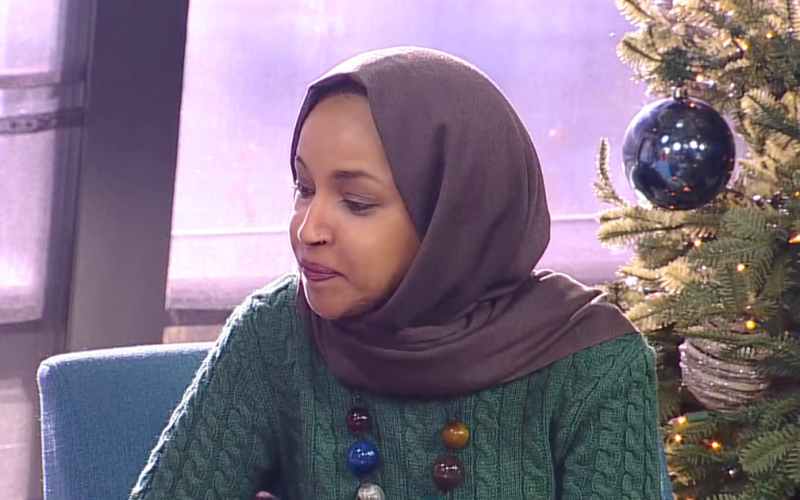
Rep. Ilhan Omar (D-MN) is facing allegations that she disclosed information about a congressional meeting to Somali leaders while serving on the House Foreign Affairs Committee, raising questions about whether sensitive discussions were improperly shared with foreign officials.
The allegations were made by Ali Hassan Muhammad, a former Somaliland minister of information, who accused Omar of passing along details concerning a meeting involving Somaliland’s president.
According to Muhammad, Omar visited the region in late 2022 and communicated information about the meeting to Somali leaders.
He further alleged that the congresswoman encouraged those leaders to take action against Somaliland before its relationship with the United States could strengthen.
The accusations have attracted attention because Omar previously served on the House Foreign Affairs Committee, which handles matters involving American foreign policy and international relations.
However, Muhammad’s statements have not been independently substantiated in the material provided, and no documentary evidence establishing that Omar improperly disclosed protected information was presented.
The allegations concern a politically sensitive period in the Horn of Africa.
Somaliland, which declared independence from Somalia in 1991, has pursued international recognition and stronger diplomatic relationships, including with the United States.
Somalia’s federal government continues to regard Somaliland as part of its territory, creating longstanding disagreements over political authority and sovereignty.
Muhammad’s accusations suggest that Omar attempted to influence developments in the region by sharing information with Somali officials.
The former minister specifically alleged that her actions were intended to encourage Somali leaders to move against Somaliland before its diplomatic position improved.
The claims also reference violence that erupted in February 2023, several months after Omar’s alleged visit.
The fighting resulted in hundreds of deaths and displaced thousands of people.
However, the timing of those events does not establish that Omar caused, encouraged or facilitated the violence.
No evidence connecting an alleged disclosure by the congresswoman to the subsequent fighting was included in the account.
The accusations nevertheless raise potentially serious questions about how congressional information is handled when lawmakers engage with foreign governments.
Members of the House Foreign Affairs Committee regularly participate in discussions involving international security, diplomatic relationships and American strategic interests.
Depending on their circumstances, some congressional discussions may involve confidential or otherwise restricted information.
However, service on the committee does not establish that every meeting or communication involves classified material.
The allegation that Omar previously held a security clearance also does not, by itself, demonstrate that the meeting contained classified information or that she violated federal law.
Determining whether misconduct occurred would require establishing precisely what information was shared, whether its disclosure was prohibited and whether Omar knowingly violated an applicable legal restriction.
The claims have prompted speculation about potentially severe consequences, including criminal prosecution.
Yet no criminal charge, indictment or official finding of wrongdoing related to Muhammad’s accusations was identified in the supplied information.
Likewise, the allegations do not establish treason, which has a narrowly defined meaning under the U.S. Constitution.
A treason prosecution would require proof of specific constitutionally defined conduct, not merely an accusation that a lawmaker communicated with foreign officials.
Suggestions that Omar could automatically face imprisonment or deportation are therefore not supported by the allegations alone.
Omar’s response to Muhammad’s specific claims was not included in the account.
The former minister’s statements leave several critical questions unanswered, including the identity of the Somali officials allegedly contacted, the precise details purportedly disclosed and whether the information was confidential.
They also do not establish whether any formal investigation has been opened.
For now, Muhammad’s accusations represent an unverified challenge to Omar’s conduct during her previous service on the House Foreign Affairs Committee.
Whether the allegations lead to further scrutiny will depend on the emergence of corroborating evidence and any official examination of the claimed disclosures.
