

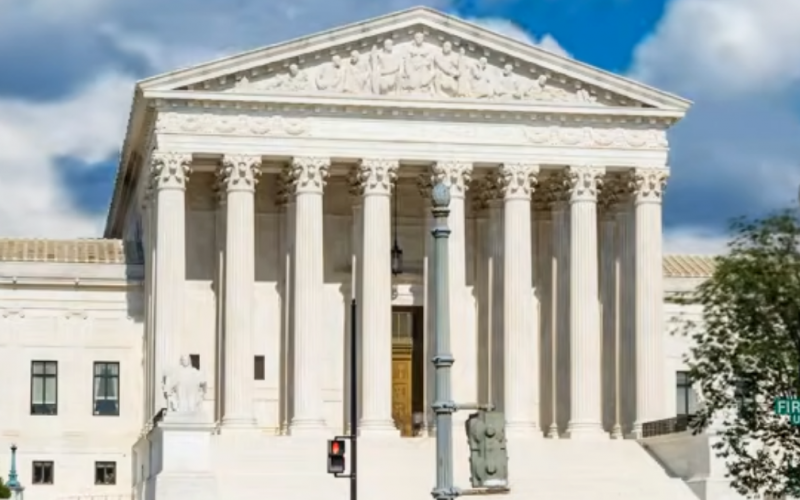
The Supreme Court on Tuesday blocked President Donald Trump’s effort to restrict birthright citizenship, ruling that children born in the United States remain citizens under the 14th Amendment regardless of their parents’ immigration status.
The 5–4 decision struck down a 2025 executive order that sought to narrow automatic citizenship for children born to illegal aliens or individuals temporarily residing in the country.
At issue was whether the Citizenship Clause permits any flexibility in defining citizenship at birth or whether it establishes a fixed constitutional rule tied strictly to birthplace.
The Court concluded that the text of the 14th Amendment, reinforced by long-standing precedent, establishes a uniform national standard that grants citizenship to nearly all individuals born on U.S. soil.
Chief Justice John Roberts wrote the majority opinion, joined by Justices Sonia Sotomayor, Elena Kagan, Ketanji Brown Jackson, Brett Kavanaugh, and Amy Coney Barrett.
He pointed to the historical foundation of the amendment, writing that it “added greatly to the dignity and glory of American citizenship” and describing citizenship as “the right to have rights.”
Trump’s executive order, signed on his first day back in office in 2025, directed federal agencies to deny citizenship documentation to children born in the United States unless at least one parent was a U.S. citizen or lawful permanent resident.
The administration argued that the phrase “subject to the jurisdiction thereof” allows limitations in cases involving noncitizen parents, particularly those unlawfully present or temporarily in the country, according to USA Today.
Lower courts had already halted the policy, with federal judges in New Hampshire and California ruling that it likely conflicted with the 14th Amendment.
Those injunctions remained in place while the Supreme Court reviewed the case, formally known as Trump v. Barbara.
The Court’s conservative bloc was divided in the ruling.
Justice Clarence Thomas wrote that the majority opinion “devalues” citizenship and questioned whether it would withstand future legal scrutiny.
Justice Samuel Alito separately called the decision a “serious mistake” in constitutional interpretation, arguing that the Court misapplied the scope of the Citizenship Clause.
Justice Brett Kavanaugh concurred in the judgment but wrote separately to emphasize narrower reasoning.
He said the executive order could not be implemented but argued the issue rested on federal immigration statutes rather than a direct violation of the Constitution itself, CNBC reported.
The administration defended the policy as an effort to correct what it described as an overly broad interpretation of the 14th Amendment and to address concerns surrounding illegal immigration and so-called “birth tourism.”
Officials argued that automatic citizenship for children of noncitizens creates incentives that strain immigration enforcement and policy consistency.
The Court rejected those arguments, instead relying on established constitutional interpretation that has historically tied citizenship to birth within U.S. jurisdiction.
The majority emphasized that the amendment was designed after the Civil War to establish a clear, uniform rule of national citizenship that could not be altered through executive action or shifting policy preferences.
In its analysis, the Court reaffirmed that the Citizenship Clause was intended to remove ambiguity surrounding citizenship and prevent states or federal officials from narrowing it through administrative or political means.
The ruling maintained continuity with prior interpretations that have governed citizenship law for more than a century.
Oral arguments were held in April, drawing major attention due to Trump’s presence in the courtroom.
The case was widely followed as one of the most significant immigration-related disputes in recent years, given its implications for executive authority and constitutional interpretation.
With the ruling, the Court left any potential change to birthright citizenship to the constitutional amendment process or congressional action, reinforcing that such authority does not rest with unilateral executive orders.
