

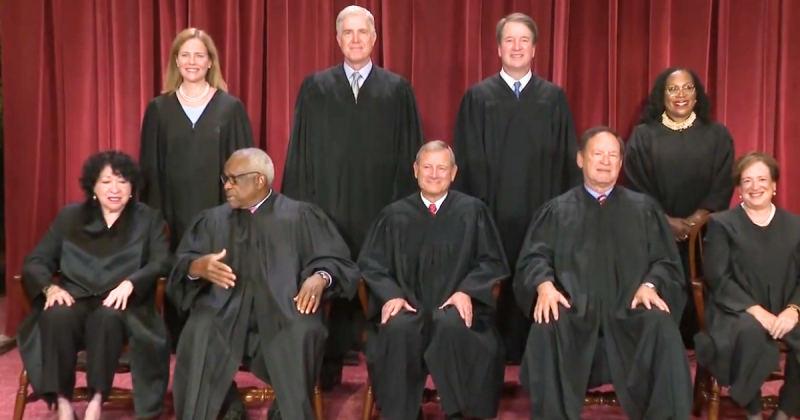
A sharply divided Supreme Court on Wednesday struck down Louisiana’s congressional map that created a second majority-black district, issuing a 6–3 decision that could reshape how states draw electoral boundaries ahead of the 2026 midterms and significantly narrow the reach of the Voting Rights Act.
The ruling immediately set off political and legal debate over the future of race-conscious redistricting in the United States.
Louisiana’s redistricting fight began after the 2020 census, when state lawmakers drew congressional boundaries that included a single majority-black district, according to Trending Politics.
After a federal court ruled that configuration likely violated Section 2 of the Voting Rights Act, the state adopted a revised map, adding a second majority-black district stretching across multiple regions, including Baton Rouge, Lafayette, and Shreveport.
That new map quickly became the subject of another legal challenge from voters who argued it relied too heavily on race.
Writing for the conservative majority, Justice Samuel Alito concluded that Louisiana’s revised districting amounted to an unconstitutional racial gerrymander, finding that race had been improperly used as the dominant factor in drawing district lines.
The court held that while the Voting Rights Act can justify limited consideration of race, it does not require states to create additional majority-minority districts unless strict legal standards are met.
“That map is an unconstitutional gerrymander,” Alito wrote for the majority, emphasizing that the use of race in this case was not supported by a sufficient legal justification under the Voting Rights Act or the Constitution’s Equal Protection Clause.
In dissent, Justice Elena Kagan warned the ruling would weaken long-standing protections against racial vote dilution and reduce the effectiveness of Section 2 of the Voting Rights Act, the Associated Press reported.
She argued the decision would make it substantially harder to challenge maps that disadvantage minority voters and could erode one of the central enforcement tools of the 1965 civil rights law.
“The consequences are likely to be far-reaching and grave. Today’s decision renders Section 2 all but a dead letter,” Kagan wrote, characterizing the ruling as a major retreat from decades of voting rights enforcement precedent.
The majority also refined how lower courts should evaluate Section 2 claims, emphasizing that minority voters are entitled to equal electoral opportunity rather than proportional representation.
The opinion further raised the evidentiary burden on plaintiffs, requiring them to clearly distinguish race-based motivations from partisan political considerations in redistricting disputes—a distinction legal analysts say could prove difficult in many states where voting patterns closely track party affiliation, according to CBS News.
The ruling is expected to have immediate national implications, particularly as states prepare for the next redistricting cycle, TP noted.
Legal experts say the decision could give legislatures greater flexibility to draw maps based on partisan goals while limiting court orders that require additional majority-minority districts under the Voting Rights Act.
At the same time, it signals increased judicial skepticism toward race-based districting absent clear statutory necessity.
Louisiana’s case has become one of the most consequential voting rights disputes in recent years, placing Section 2 of the Voting Rights Act under renewed scrutiny.
While the court stopped short of dismantling the provision entirely, its narrowing interpretation has fueled debate over whether the law’s core protections against racial discrimination in voting have been significantly weakened heading into a high-stakes election cycle.
WATCH:
