

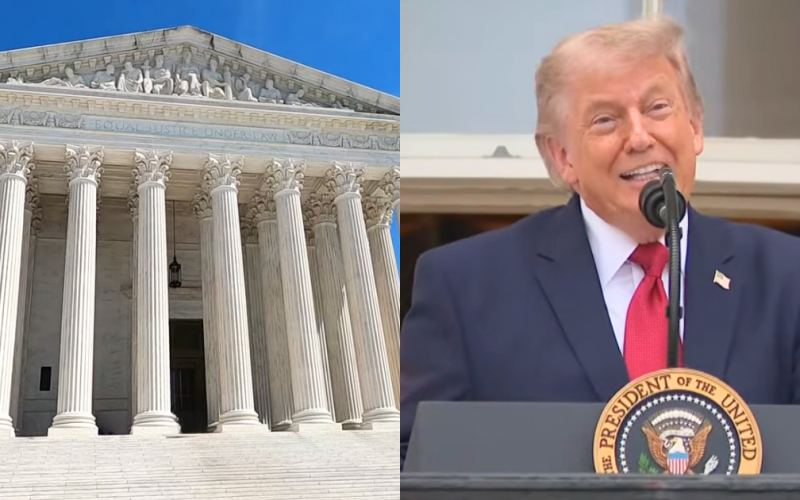
The Supreme Court on Tuesday struck down federal limits on coordinated spending between political parties and candidates, delivering a significant legal victory for Republicans and reshaping how millions of dollars may be deployed in future elections, including the 2026 midterms.
The 6–3 ruling found that longstanding restrictions under federal campaign finance law violate the First Amendment’s protection of political speech.
At issue in National Republican Senatorial Committee v. Federal Election Commission was whether limits imposed under the Federal Election Campaign Act improperly restricted political parties from working directly with their own candidates on campaign spending.
The Court concluded that the restrictions burdened core political expression and could not stand under constitutional scrutiny.
Writing for the majority, Justice Brett Kavanaugh said the coordinated-expenditure caps placed an unconstitutional burden on political communication between parties and candidates.
He described the restrictions as a “severe infringement on First Amendment-protected political speech,” arguing that political parties exist to support their candidates and should not be artificially constrained in doing so, Trending Politics reported.
Kavanaugh further wrote that the limits distorted the political system by weakening parties while empowering outside groups.
“To uphold the political-party coordinated-expenditure limits here could therefore help consign political parties to continued second-tier status as compared to outside groups,” he wrote, adding that weakened parties ultimately “distort the political system.”
The decision removes caps that previously restricted how much national party committees could spend in direct coordination with candidates.
Under the prior framework, coordinated spending was capped at varying levels depending on the office, including different limits for House, Senate, and presidential races.
Those restrictions are now invalidated.
Republicans argued in the case that super PACs and outside groups had already eclipsed political parties in influence, effectively creating “shadow parties” that operate without meaningful coordination limits, according to The Western Journal.
The Court’s ruling restores a broader role for formal party committees in campaign activity.
Democrats and campaign finance reform advocates warned that the ruling could increase the influence of wealthy donors and special interests in elections by allowing larger sums of money to flow directly through party structures aligned with candidates.
Critics said the decision continues a broader trend of deregulating political spending.
The case originated in 2022 when the National Republican Senatorial Committee, along with then–Senate candidate JD Vance and former Rep. Steve Chabot, challenged the federal limits.
The plaintiffs argued that the restrictions violated the First Amendment by limiting how political parties can engage in direct campaign advocacy with their own nominees.
The Biden administration declined to defend the law in court, leaving the argument to court-appointed counsel.
The Court ultimately sided with the challengers, reinforcing earlier decisions that have expanded First Amendment protections in campaign finance cases.
Justice Kavanaugh emphasized that political parties have historically played a central role in American elections, noting that for much of the nation’s history, parties operated without similar federal coordination limits.
He argued that the modern restrictions were inconsistent with that tradition and with constitutional protections for political speech, according to The Post Millennial.
The ruling is expected to have immediate implications for the 2026 midterm elections.
Party committees will now be able to more directly fund advertising, messaging, and field operations in coordination with their candidates, potentially increasing the scale and efficiency of campaign spending in competitive districts and states.
Republican leaders praised the decision, calling it a restoration of political speech and a leveling of the playing field between parties and outside political organizations.
Democratic officials sharply criticized the ruling, warning it could amplify the role of large donors in shaping campaign strategy and messaging.
The decision continues a long line of Supreme Court rulings, including Citizens United, that have eased restrictions on political spending by interpreting campaign finance limits through the lens of the First Amendment.
The latest ruling further strengthens the role of party committees in coordinated electoral activity while reducing federal constraints on their financial operations.
